
Investing
Trump Tantrums - Why and What this means to an Indian Investor

FabTrader
Article overview
Imagine handing someone a credit card, letting them swipe it with abandon—until one day, you realize the limit’s been reached, the bills are piling up, and the only way forward is to pay. That’s the situation the U.S. now faces with its debt. The $37 trillion national debt is just the tip of a vast iceberg. Behind it...
Imagine handing someone a credit card, letting them swipe it with abandon—until one day, you realize the limit’s been reached, the bills are piling up, and the only way forward is to pay. That’s the situation the U.S. now faces with its debt. The $37 trillion national debt is just the tip of a vast iceberg. Behind it lies a tangle of obligations—intergovernmental debt, corporate liabilities, off-balance sheet promises—that could push the true burden well past $100 trillion.
Into this fraught landscape steps Donald Trump, wielding trade wars, tariff escalations, and visa restrictions. Are they tantrums or strategy? And what do these maneuvers mean for Indian investors navigating equities, gold, Bitcoin, and the rising shadow of stablecoins like USDT?
The Debt That Ate America
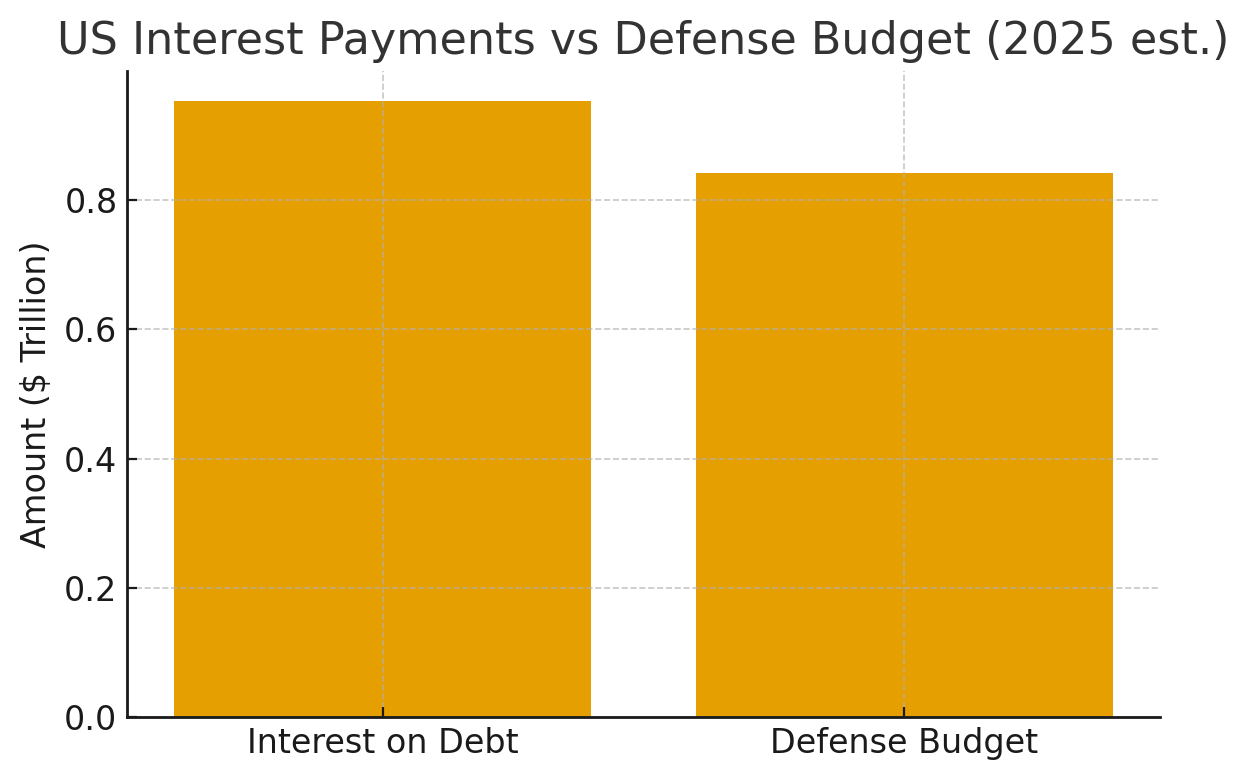
In 2024, for the first time in U.S. history, interest payments on the national debt overtook defense spending.
That’s not just a symbolic inflection point—it’s a structural problem. According to budget projections, the U.S. is estimated to shell out $952 billion in interest in 2025 alone, with interest becoming one of the fastest-growing parts of the budget.
When interest costs approach — or even crowd out — defense and infrastructure, a country’s leeway to project power or invest in its future shrinks dramatically. It’s a classic “crowding out” scenario.
Some analysts call this the “Ferguson limit”—a threshold signaling that a great power has overleveraged itself. Historically, when Britain’s financial obligations swallowed its military ambitions, it ceded global ascendancy. The parallel is hard to miss.
Yet the official $37 trillion is only the public face. There’s intragovernmental debt (owed from trust funds to the federal government), promises such as pensions and healthcare, and corporate and derivative obligations that rarely show up in headline figures. Add them all, and studies suggest the broader U.S. liability could stretch past $100 trillion.
So the question isn’t just “Will they default?” but “When will the system crack?”
Trump’s Chess Moves: Method in the Madness?
Trump isn’t just flailing; he might be maneuvering. Here’s how:
- Tariffs as revenue levers
The Congressional Budget Office estimates that the tariffs introduced by the Trump administration could raise $3.3 trillion in revenue over the next ten years and shave $0.7 trillion off interest payments.
But critics argue it’s not nearly enough. The CBO suggests that these additional revenues won’t cover projected deficits over the same period. - Pressuring the Fed
Trump’s push for lower interest rates isn’t random. Lower rates would reduce debt service costs, buying breathing room for the U.S. budget—though at the risk of inflation or financial market instability. - Revaluing hidden assets
Some proponents point to gold reserves held at artificially low book values. Revaluation could, on paper, shrink the debt ratio. It’s a speculative lever, but in times of desperation, symbolic economics matter. - Geo-economic pressure on trading partners
The aggressive tariff and visa strategies—especially targeting India—serve dual roles: to generate revenue and reengineer power flows. Trump’s imposition of 50% tariffs on Indian imports has been widely noted as both economic and geopolitical. - Supply chain reconfiguration & “reshoring”
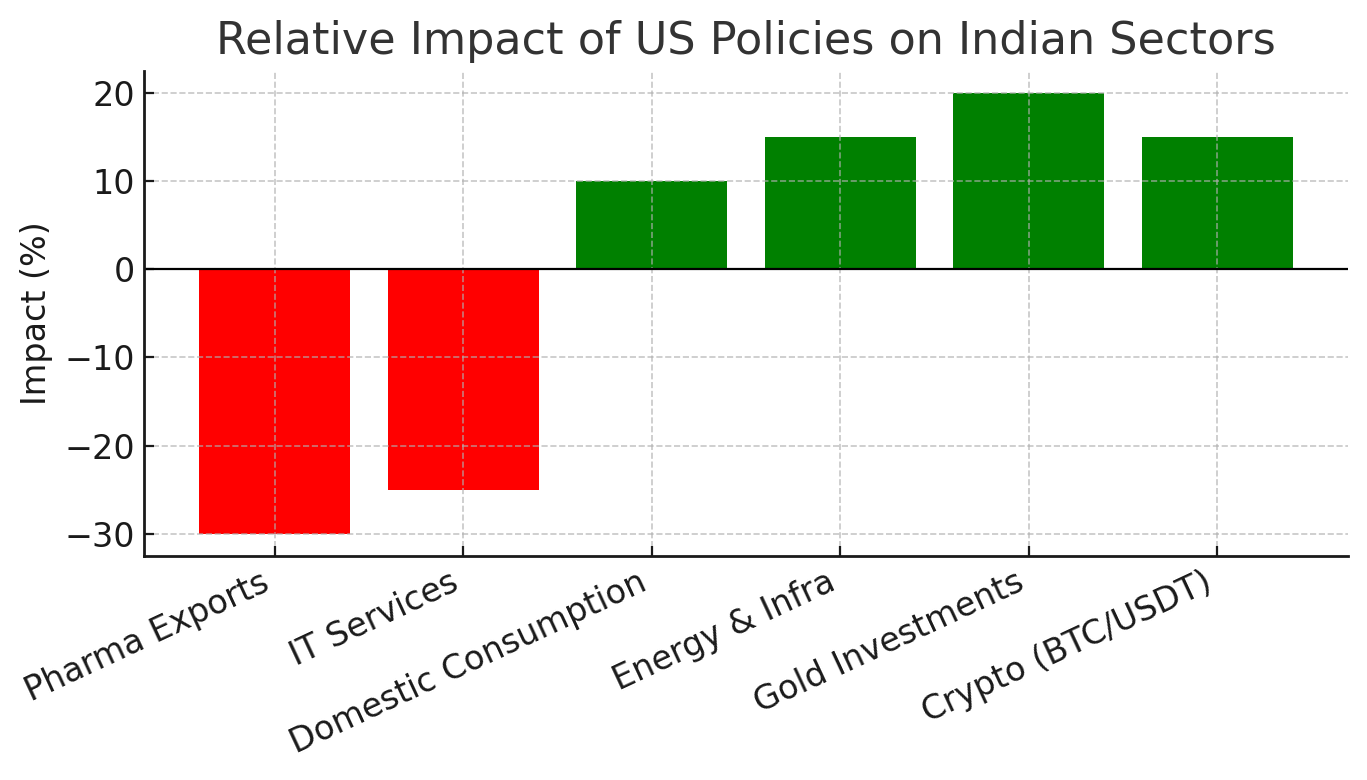
By squeezing Indian pharma and IT sectors via tariff hikes and H-1B visa fee increases, the administration signals a push for domestic production and tighter control over strategic sectors.
In effect, Trump’s playbook seems designed to shift leverage—from foreign creditors and trading partners—back toward the U.S., at least temporarily.
From London to Washington: The Great Power Debt Transition
In the 19th and early 20th centuries, Britain’s global dominance was tied to its role as a financial center. But as its debt burden grew and wars cut its capacity, it slowly ceded that role. The U.S. then inherited the dollar-based system.
Now, the question is whether the U.S. is approaching a similar inflection. With debt spiraling, rising interest, and fiscal flexibility shrinking, the global order may shift again. Candidates for alternative centers include China (with its Belt and Road network), the Gulf (with petrodollar capital), or a basket of currencies combined with gold-backed digital assets.
For India and emerging markets, that shift could redraw financial maps.
Strategy Playbook for Indian Investors
The U.S. debt spiral and Trump’s high-stakes economic maneuvers aren’t just Washington headlines — they ripple directly into Dalal Street portfolios. Here’s how Indian investors should navigate this period of flux:
1. Protect the Core: Build a Resilient Foundation
- Emergency corpus: Keep at least 12–18 months of expenses in liquid assets (bank deposits, liquid mutual funds, short-term debt). In volatile global cycles, cash is king.
- Debt allocation: Stick to high-quality Indian debt funds or government securities. Avoid chasing U.S. high-yield debt or exotic bond ETFs that could crack if the dollar weakens.
- Insurance check: Ensure adequate health and term life insurance. Unexpected U.S. policy shocks can translate into sudden job losses or inflationary surges at home.
2. Equities: Tread Selectively
- Avoid overexposure to U.S.-dependent sectors: Indian pharma and IT services are under direct tariff and visa pressure. These sectors may lag.
- Favor domestic themes: Consumption (FMCG, retail), infrastructure, energy, and banking stand to benefit from India’s inward growth story, relatively insulated from U.S. noise.
- Cyclical opportunities: Corrections in export-heavy names (Infosys, Sun Pharma, TCS, etc.) could offer short-term deltas for nimble traders, but long-term allocations should tilt toward domestic plays.
3. Gold: A Strategic Hedge
- Gold thrives during debt-driven uncertainty.
- Maintain 10–15% allocation in physical gold, sovereign gold bonds, or gold ETFs.
- For tactical players, keep an eye on global chatter about gold-backed digital dollars or revaluation of U.S. reserves — either could trigger a sharp rally.
4. Crypto & Stablecoins: Utility, Not Core
- Bitcoin: Treat it as a speculative hedge (2–5% max). Its volatility remains high, but it offers a play against fiat instability.
- USDT & Stablecoins: Useful for short-term parking or cross-border liquidity, but not a long-term wealth store. They earn no yield, and regulatory risk is real.
- Opportunities: Indian exchanges offering yields on stablecoins may look tempting, but weigh counterparty and regulatory risks before allocating.
5. Global Diversification
- Use international mutual funds or ETFs to spread risk across geographies, but avoid over-weighting the U.S. in this cycle.
- Emerging markets (ex-U.S.) and Asia (especially India, ASEAN) may offer higher resilience if global capital rotates away from the dollar.
6. Opportunities in Transition
- Quick delta bets: Short-term traders can exploit volatility in IT and pharma on tariff news cycles.
- Energy transition: India’s renewable and energy-infra sectors are likely to attract foreign inflows as capital seeks alternatives to U.S. bonds.
- Financial services: Domestic banks benefit from higher consumption and credit growth, even as exporters face U.S. headwinds.
Special Focus: For Investors Nearing Retirement (0–2 years away)
This group cannot afford to gamble — capital preservation trumps growth.
- Shift to safety: Keep 60–70% of assets in debt and fixed-income instruments, ideally staggered (laddered bonds, deposits, debt mutual funds).
- Reduce U.S. exposure: Trim allocations to U.S.-sensitive Indian equities (IT, pharma). Stick to defensive domestic sectors.
- Gold as an insurance policy: Hold 10–12% in gold, enough to hedge dollar instability.
- Minimal crypto exposure: A token allocation (1–2%) in Bitcoin or stablecoins is fine for optionality, but don’t let it endanger retirement security.
- Drawdown strategy: Consider moving 24–36 months of retirement expenses into ultra-safe liquid instruments now. This shields you from forced redemptions during a market drawdown.
Key Takeaway
- For long-term investors: Stay diversified, lean into India’s domestic story, and keep gold/crypto as hedges.
- For those retiring soon: Lock in safety, preserve cash flow, and treat this period as one to defend, not attack.
- For opportunistic traders: Volatility in IT, pharma, gold, and crypto creates tactical opportunities — but timing is everything.
Final Word
The U.S. has maxed out its credit card. Trump’s moves look aggressive, but they’re not random tantrums—they appear to follow a bruising strategy to rebalance leverage. For Indian investors, the road ahead demands creativity, caution, and opportunism. We may be entering a decade where the axis of financial power tilts—and only those positioned well will navigate it alive.
References & Further Reading
- “For the First Time, the U.S. Is Spending More on Debt Interest than Defense” — Council on Foreign Relations
https://www.cfr.org/blog/first-time-us-spending-more-debt-interest-defense Council on Foreign Relations - “Interest on the Debt Surging Past National Defense” — EPIC for America
https://epicforamerica.org/federal-budget/interest-on-the-debt-surging-past-national-defense/ EPIC for America - “Any Way You Look at It, Interest Costs on the National Debt Will Soon Be at an All-Time High” — Peter G. Peterson Foundation
https://www.pgpf.org/article/any-way-you-look-at-it-interest-costs-on-the-national-debt-will-soon-be-at-an-all-time-high/ Peterson Foundation - “Interest Costs on the National Debt” — Peter G. Peterson Foundation (Monthly Interest Tracker)
https://www.pgpf.org/programs-and-projects/fiscal-policy/monthly-interest-tracker-national-debt/ Peterson Foundation - “Ferguson’s Law: Debt Service, Military Spending, and the Fiscal Limits of Power” — Hoover Institution
https://www.hoover.org/research/fergusons-law-debt-service-military-spending-and-fiscal-limits-power Hoover Institution - “In FY2024, the federal government spent more on interest payments on the national debt ($882 billion) than it did on discretionary outlays for national defense ($874 billion)” — Bipartisan Policy Center
https://bipartisanpolicy.org/explainer/why-the-national-debt-matters-for-national-security/ Bipartisan Policy Center - “Trump to impose $100,000 fee per year for H-1B visas, in blow to tech” — Reuters
https://www.reuters.com/business/media-telecom/trump-mulls-adding-new-100000-fee-h-1b-visas-bloomberg-news-reports-2025-09-19/ Reuters - “‘Afraid of our talent’: India hits back against Trump’s H-1B visa fee hike” — The Guardian
https://www.theguardian.com/world/2025/sep/22/trump-india-h1-b-visa-fee-hike-response-afraid-of-talent The Guardian - “Cruel joke: How Indian H-1B dreams are crash-landing after Trump fee hike” — Al Jazeera
https://www.aljazeera.com/features/2025/9/29/cruel-joke-how-indian-h-1b-dreams-are-crash-landing-after-trump-fee-hike Al Jazeera - “US Firms To Consider Shifting Work To India As Trump Hikes H-1B Visa Fee” — NDTV
https://www.ndtv.com/world-news/us-firms-to-consider-shifting-work-to-india-as-trump-hikes-h1-b-visa-fee-9369365 www.ndtv.com
More from Investing
Is the Stock Market Quietly Killing Human Creativity and productivity?
For centuries, human progress has been driven by people who built things—engineers, scientists, entrepreneurs, artists and inventors. But as financial markets become...
Beyond Returns: Why I Built a More Intelligent Midcap Mutual Fund Screener
Looking for the best midcap mutual funds in India? This article explains how our Midcap Mutual Fund Screener goes beyond traditional return-based...
How to Build a robust Passive Index Investing System that works
Passive investing has transformed the way investors build wealth. But with so many choices—from Nifty 50 Index Funds and Nifty Next 50...