
Investing
How to Build a robust Passive Index Investing System that works

FabTrader
Article overview
Passive investing has transformed the way investors build wealth. But with so many choices—from Nifty 50 Index Funds and Nifty Next 50 Funds to S&P 500, NASDAQ 100, and Smart Beta indices—many investors find themselves overwhelmed by options. In this article, I share the FabTrader Passive Investing Framework, a simple Core-Satellite portfolio approach designed to help investors build a diversified, low-cost, and long-term investment portfolio using the best index funds and passive investment strategies available in India.
Passive investing has become one of the most popular investing approaches in recent years, and for good reason. Numerous studies have shown that a large percentage of actively managed funds struggle to consistently beat their benchmark indices over long periods. As a result, more investors are turning towards index mutual funds as a low-cost and transparent way to participate in market growth.
However, the moment someone decides to start investing in index funds, a new challenge appears.
Which index should you choose?
Should you invest in the Nifty 50 or Nifty Next 50? Is it worth adding international exposure through the S&P 500 or NASDAQ 100? Do factor indices such as Momentum, Value, and Alpha deserve a place in a portfolio? And how much diversification is actually enough?
These are the questions I wanted to answer while building my own passive investing framework. Rather than looking for a single "best" index fund, I wanted a system that could provide broad diversification, low costs, and a sensible allocation across different segments of the market.
In this article, we will try to build a robust passive investing model using only index mutual funds.
Why Most Investors Overcomplicate Passive Investing
One of the biggest ironies in investing is that many passive investors behave exactly like active investors.
They spend hours comparing returns between index funds, analysing short-term performance differences, and trying to identify which fund has delivered the highest returns over the last three years. In many cases, investors end up switching from one index fund to another because they discover a competing fund that has outperformed by a small margin.
The problem with this approach is that it focuses on the wrong variable. When selecting an index fund, the goal is not to find the fund that happened to outperform in the recent past. The goal is to find the most efficient vehicle for tracking a particular index while keeping costs low.
A successful passive investor does not need to predict future winners. Instead, they need a portfolio structure that allows them to stay invested through market cycles without constantly making changes.
The Core-Satellite Approach (70%)
The framework is built around a simple Core-Satellite model. The idea is straightforward. The majority of your investments should be allocated to a core portfolio that captures the growth of India's largest and most established companies. Around this core, smaller satellite allocations can be added to provide diversification across geographies, factors, and broader market segments.
My preferred allocation looks like this:
- Core Portfolio: 70%
- Satellite Portfolio: 30%
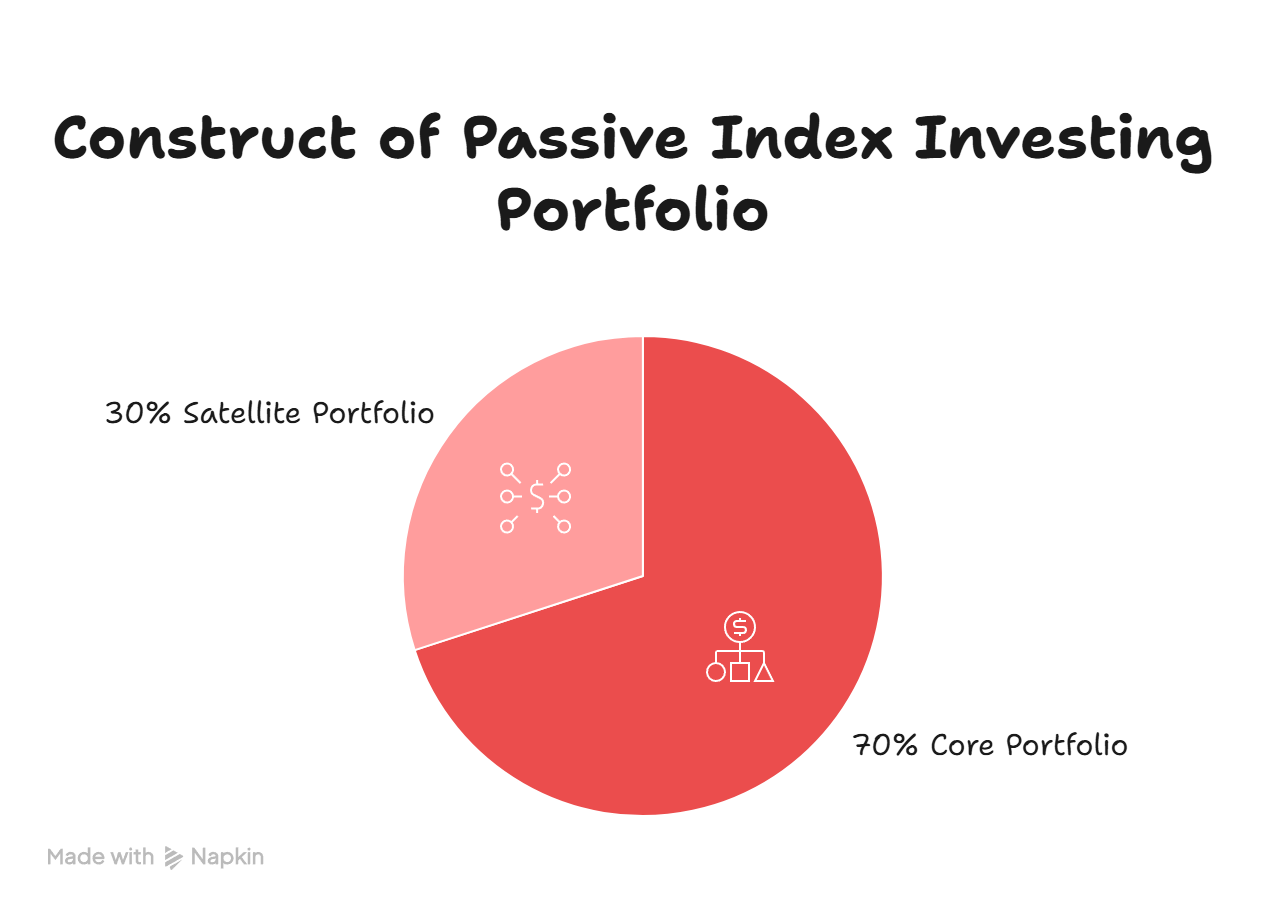
The satellite portfolio is further divided equally across three different buckets. This structure keeps the portfolio simple while ensuring that investors are not dependent on a single market segment or investment style.
Bucket 1: The Foundation of the Portfolio (70%)
The first bucket forms the core of the portfolio and receives the largest allocation. This bucket consists of large-cap indices such as the Nifty 50, Nifty Next 50, Nifty 50 Equal Weight Index, and the Nifty 100. These indices represent some of the strongest and most established businesses in the country.
The purpose of this bucket is not to outperform the market. Its purpose is to capture India's long-term economic growth in a simple and efficient manner.
Large-cap companies tend to have proven business models, stronger balance sheets, and greater liquidity compared to smaller companies. They are often the first beneficiaries of economic expansion and typically form the backbone of most long-term investment portfolios.
For many investors, this bucket alone may be sufficient. However, adding complementary exposures can improve diversification and potentially enhance long-term outcomes.
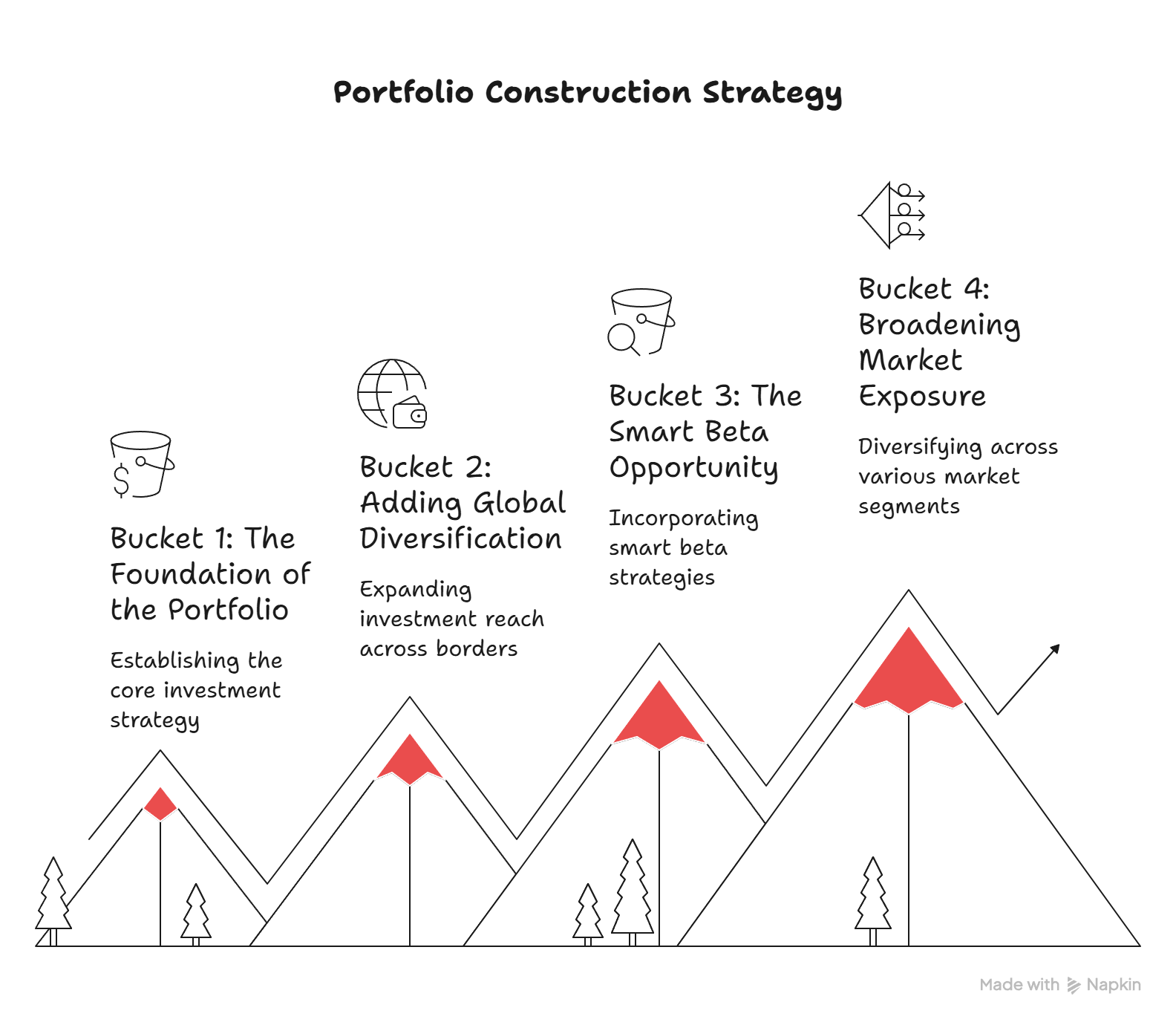
Bucket 2: Adding Global Diversification (10%)
Many Indian investors have most of their financial life tied to India. Their salary depends on the Indian economy, their real estate is located in India, and their investments are often concentrated in Indian equities.
While there is nothing wrong with being optimistic about India's future, concentration risk should not be ignored. This is where international index funds can play an important role.
Indices such as the S&P 500 and NASDAQ 100 provide exposure to some of the world's largest and most innovative companies. They allow investors to participate in sectors and businesses that may not have equivalent representation in Indian markets.
The purpose of this bucket is not to make a prediction about whether the United States will outperform India. Rather, it is to ensure that your portfolio is not entirely dependent on the performance of a single country.
Bucket 3: The Smart Beta Opportunity (10%)
The third bucket focuses on factor investing, often referred to as Smart Beta investing. Traditional index funds allocate money based on market capitalization. Factor indices take a different approach by selecting stocks based on specific characteristics that have historically been associated with excess returns.
Popular examples include Momentum, Value, Alpha, and Low Volatility indices. Momentum strategies aim to capture stocks that are already demonstrating strong price trends. Value strategies focus on companies trading at relatively attractive valuations. Low-volatility strategies seek to reduce portfolio fluctuations during difficult market periods.
While factor investing remains rules-based and systematic, it introduces an additional layer of strategy beyond traditional index investing. For investors willing to tolerate periods of underperformance, factor indices can serve as an interesting complement to a core passive portfolio.
Bucket 4: Broadening Market Exposure (10%)
The final bucket focuses on expanding exposure beyond traditional large-cap investing. Indices such as the Nifty 500 and Sensex provide access to a wider universe of companies. In particular, the Nifty 500 captures a substantial portion of India's listed market capitalization across large-cap, mid-cap, and small-cap segments.
This allocation recognises an important reality of investing: tomorrow's market leaders are often today's smaller companies. By including a broader market allocation, investors increase the likelihood of participating in the growth of emerging businesses before they become household names.
How I Rank Index Funds
Once we decide which index we want exposure to, the next step is selecting the actual mutual fund. Rather than focusing on past returns, I believe three factors deserve the highest attention. The first is Expense Ratio. Lower costs leave more money invested and compounding over time.
The second is Tracking Error. An index fund should closely replicate the performance of its benchmark. Lower tracking error indicates better execution by the fund house.
The third is AUM Strength. Larger funds generally benefit from better liquidity and operational efficiency, although this should be viewed as a supporting factor rather than the primary criterion.
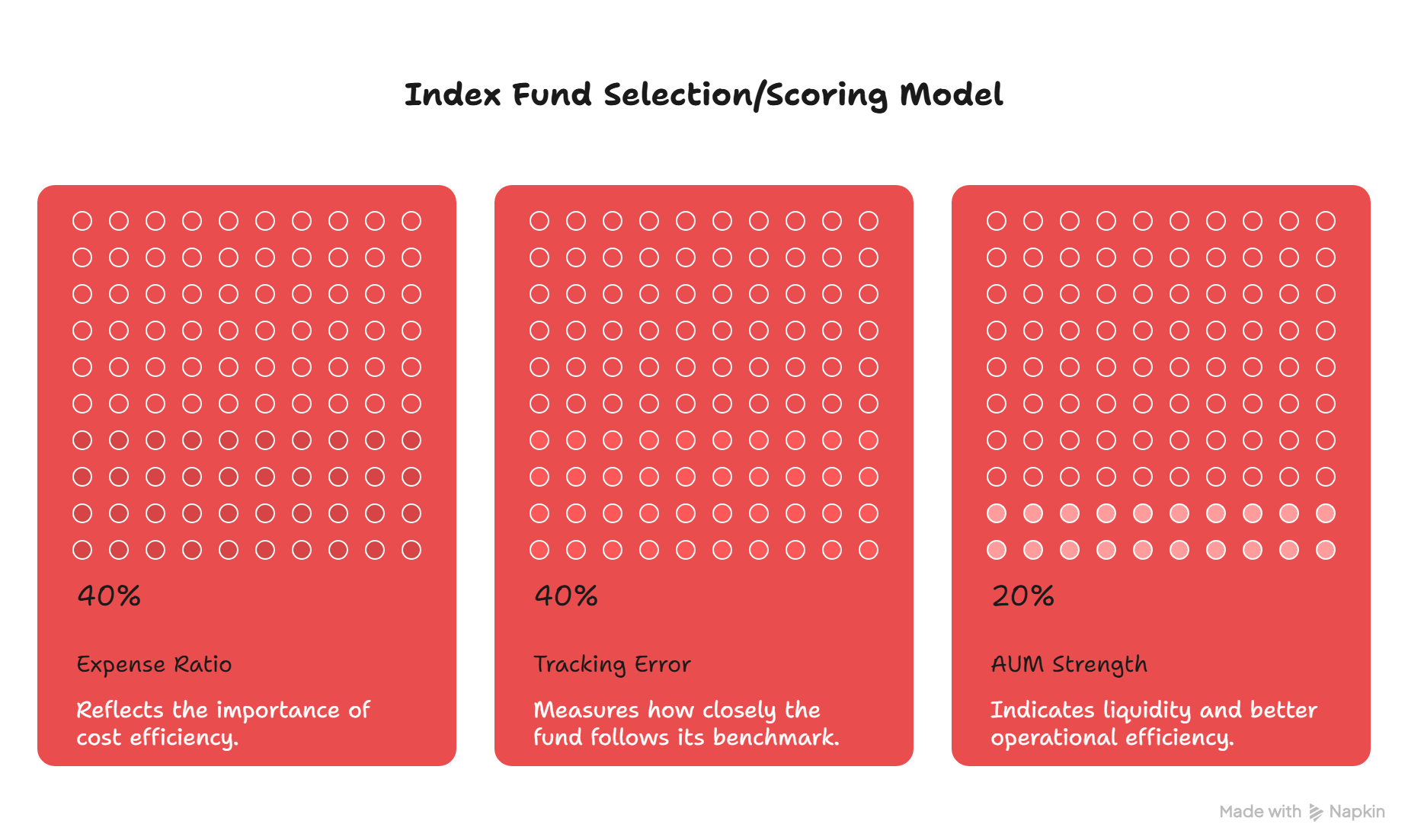
To make the selection process more objective, I created a scoring model that assigns:
- 40% weight to Expense Ratio
- 40% weight to Tracking Error
- 20% weight to AUM Strength
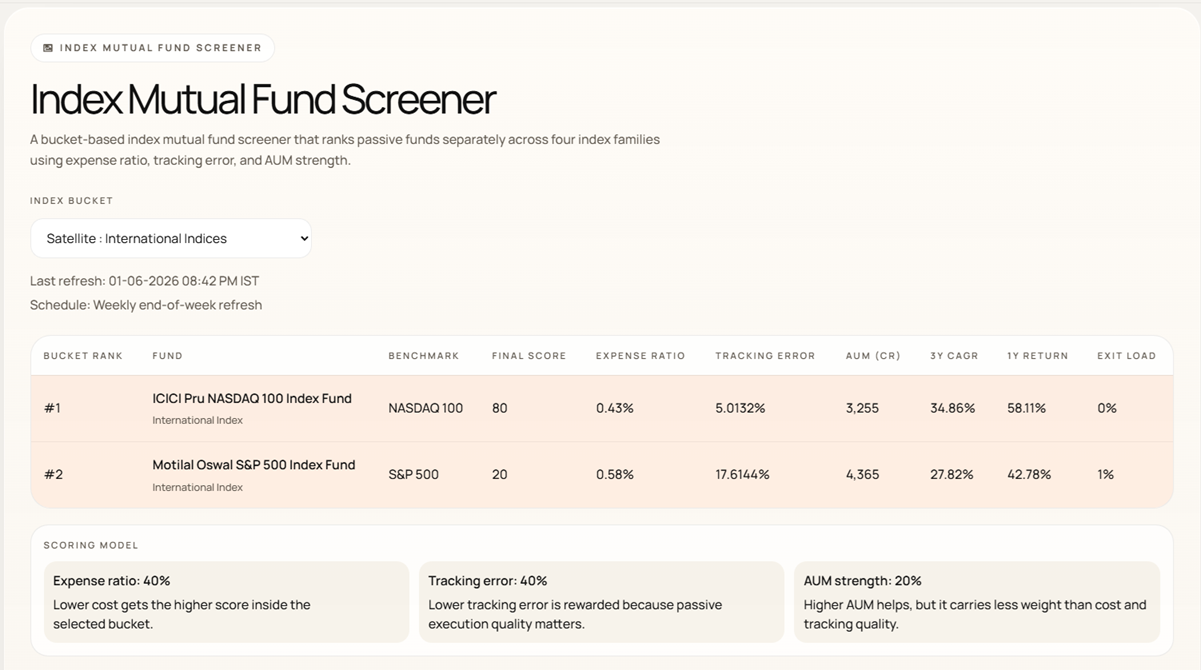
Using this methodology, I rank the available index funds within each bucket and identify the strongest candidates.
FabTrader Index Fund Screener
While building this passive investing framework, I realized that selecting the right index mutual fund from a sea of funds is a real challenge. To simplify this process, I built the FabTrader Index Fund Screener. The screener evaluates and ranks index mutual funds using a weighted scoring methodology that focuses on three key factors discussed above. The tool is free to use.
Final Thoughts
The purpose of this framework is not to identify the perfect index fund. The purpose is to create a simple, diversified, and repeatable investing system that can survive multiple market cycles.
Markets will change. Sectors will rotate. New themes will emerge while old themes fade away. Through all of this, a disciplined passive investing approach allows investors to focus on what truly matters: staying invested, controlling costs, and allowing compounding to do its work.
The FabTrader Passive Investing Framework is built on that philosophy. A strong foundation, sensible diversification, and a systematic approach to selecting index funds can go a long way in helping investors build wealth over the long term.
Hope you found this useful. Suggestions and improvements most welcome. Happy Investing!
More from Investing
Is the Stock Market Quietly Killing Human Creativity and productivity?
For centuries, human progress has been driven by people who built things—engineers, scientists, entrepreneurs, artists and inventors. But as financial markets become...
Beyond Returns: Why I Built a More Intelligent Midcap Mutual Fund Screener
Looking for the best midcap mutual funds in India? This article explains how our Midcap Mutual Fund Screener goes beyond traditional return-based...
A Simple, Peaceful ETF Rotation Strategy That Delivered 32% CAGR
Markets are constantly shifting leadership between sectors, asset classes, and global markets. Instead of trying to predict where the next opportunity might...