
Algo Trading
Algo Trading Cost in India: How I Built a Reliable Setup for ₹150/Month

FabTrader
Article overview
Wondering how much algo trading costs in India? In this article, I break down the real expenses involved in running an algorithmic trading setup — including broker APIs, VPS hosting, data feeds, and trading tools. I also share how I rebuilt my own live algo trading infrastructure to run reliably at just ₹150 per month without compromising stability, flexibility, or performance. Perfect for retail traders, Python developers, and anyone interested in building a sustainable low-cost algo trading setup in India.
A few days ago, I came across a Reddit post where someone mentioned they were spending more than ₹8,500 every month just to run their algo trading setup. Honestly, that number shocked me. Not because algo trading is cheap — it definitely isn’t — but because ₹8,500 per month for a retail trader is simply not sustainable over the long run.

That post stayed in my mind for a while. It made me wonder how many people quietly assume these costs are “normal” and continue paying them month after month. Worse, how many aspiring algo traders never even begin because the internet makes algorithmic trading look like an expensive game reserved only for people with deep pockets and institutional infrastructure.
So I decided to experiment with my own setup.
Instead of writing another vague article about “cost optimization,” I wanted to create a practical roadmap that I could personally test in production. Something real. Something stable. Something that could genuinely help retail traders reduce unnecessary expenses without compromising reliability.
Over the last few weeks, I rebuilt my entire infrastructure from scratch with one clear goal: reduce operational costs as much as possible while still maintaining a robust and dependable trading setup.
The result surprised even me. Today, my complete algo trading setup costs around ₹150 per month. That is cheaper than a good cup of coffee in most cafés.
And no, this is not some temporary hobby setup running from an old laptop in the corner of my room. This is a proper live trading environment running multiple accounts, multiple brokers, strategy execution, data pipelines, monitoring systems, and automated deployment workflows.
In this article, I’ll walk you through where most algo traders end up overspending and how I managed to reduce costs dramatically without sacrificing stability.
The Hidden Trap Most New Algo Traders Fall Into
Most people enter algo trading with excitement. They watch a few YouTube videos, browse Reddit threads, follow trading creators on Twitter, and slowly start building what they think is a “professional” setup.
But somewhere along the way, many traders start accumulating subscriptions like collectibles. Multi-monitor setup, a premium charting tool here. A scanner subscription there. Paid APIs. A hosted strategy platform. Multiple analytics dashboards. VPS hosting they barely understand. Another tool someone online called “essential.”
Individually, none of these expenses feel large. But collectively, they quietly become a serious recurring monthly cost.
The real problem is that many traders paying these costs are not even consistently profitable yet. At that stage, operational expenses themselves become a source of pressure. You’re no longer just fighting the market — you’re also trying to justify your monthly subscriptions.
Where Does All the Money Actually Go?
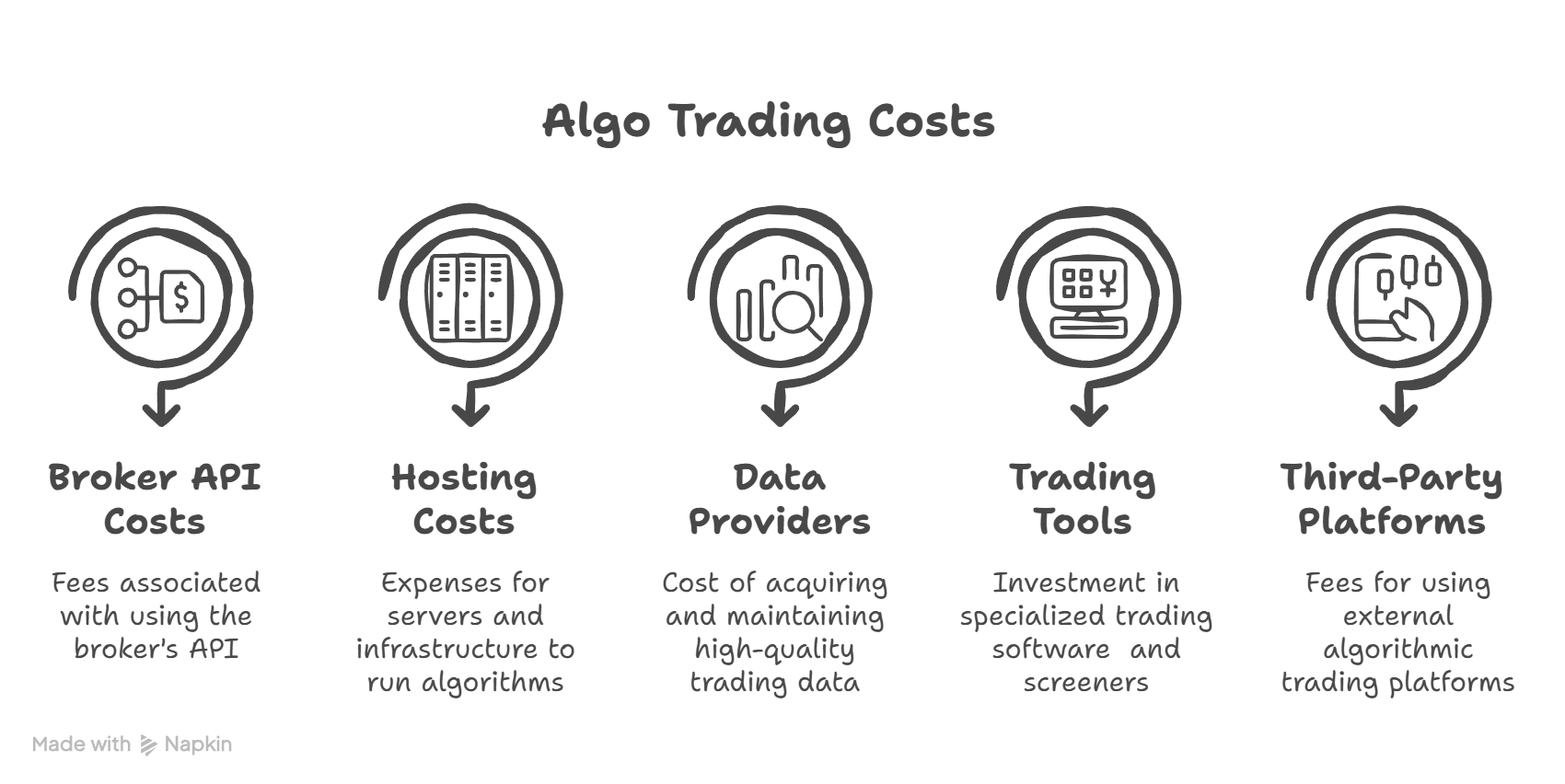
After speaking with many traders over the years, I realized that most algo trading expenses usually fall into a few predictable categories.
Broker API Costs
Some brokers offer free APIs while others charge monthly fees for access. A few years ago, API access itself felt like a premium feature reserved for “serious traders.” Thankfully, the ecosystem is improving and pricing has become more reasonable in some cases.
Still, if you operate multiple accounts, even a ₹500 monthly API fee per account starts adding up quickly. Personally, I’ve always felt brokers should ideally provide APIs for free because active algo traders already generate significant trading volume for them. But for now, it remains a recurring expense many traders underestimate.
Hosting Costs
This is one area where I believe traders should not cut corners recklessly.
If your strategy depends on uptime, stable internet connectivity, and uninterrupted execution, running trades from your personal laptop is simply not enough. A power cut, Windows update, internet issue, or accidental restart can completely disrupt live execution.
I know some people proudly say they run their strategies from their bedroom PC. In my opinion, that is more automation than actual algorithmic trading.
A reliable server is not optional. It is foundational infrastructure.
Data Quality
This is one of the most underrated problems in Indian algo trading.
Almost every experienced trader has faced issues with inaccurate candles, inconsistent timestamps, missing data points, or unreliable historical data. The scary part is that many traders don’t even realize their backtests are based on flawed datasets.
A strategy built on inaccurate historical data can create completely false confidence. It may look amazing during testing and collapse instantly in live markets.
Good data is not a luxury. It is survival.
Expensive Trading Tools
Many traders rush into buying every premium tool they discover online. To be fair, a lot of these tools are genuinely excellent products. Platforms for charting, screening, and analytics can be incredibly powerful.
But most retail traders do not actually use even half the features they are paying for.
Once you learn basic Python and automation, you slowly realize that many workflows can be recreated yourself. Not immediately, of course, but gradually over time.
And once you start building your own tools, you become far less dependent on expensive ecosystems constantly trying to upsell new subscriptions.
Third-Party Algo Platforms
This is probably the biggest recurring cost for many traders.
A lot of people use ready-made algo trading platforms where they either rent strategies or build simple rule-based systems using drag-and-drop interfaces. Some platforms even charge additional profit-sharing commissions every month.
While these platforms are convenient, many operate like black boxes. You don’t fully understand the internal execution architecture, order handling, or risk systems. More importantly, you become dependent on someone else’s ecosystem. That dependency becomes expensive over time.
My Experiment
I’ve been building and running algo trading systems for more than eight years now. What started as curiosity slowly evolved into a mature ecosystem that now comfortably replaces my yearly income — and then some.
But this didn’t happen overnight. There was no magical strategy or breakthrough moment. The system evolved gradually over years through constant iteration, testing, failures, and improvements. One script at a time. One deployment at a time.
My earlier infrastructure was hosted primarily on AWS Linux servers with multiple broker integrations and paid APIs across family accounts.
Initially, AWS feels fantastic because the free tier creates the illusion that everything is inexpensive. But slowly the hidden costs start appearing. Storage charges, bandwidth costs, monitoring expenses, additional services, feature limitations, static IP pricing — everything slowly stacks up.
And once the free tier expires, the monthly bill suddenly becomes much larger than expected. At one point, my operational costs crossed ₹2500 per month. While that amount may not sound huge, I started questioning whether I was actually receiving enough value for that spending.
That’s when I decided to rebuild the entire setup from scratch with one objective: aggressively reduce costs without compromising reliability.
That second part was important. Reducing cost is easy. Building a low-cost system that remains stable during live trading is the real challenge.
My New ₹150/Month Setup
After testing multiple configurations, providers, and deployment workflows, I finally arrived at a setup that I’m genuinely happy with. Interestingly, the new setup is actually simpler than my previous one.
Hosting
For hosting, I moved to a self-managed Linux VPS instead of relying on expensive cloud ecosystems. A few years ago, self-managing servers felt intimidating for most retail traders. Today, with tools like ChatGPT available, managing Linux servers has become far more approachable than people imagine.
I tested several hosting providers over multiple weeks. Some were excellent, some unstable, and a few looked outright suspicious. One India-based provider literally asked for Aadhaar details and Aadhaar PIN information directly on their website — which is an immediate red flag.
Please stay away from providers like that. Eventually, I settled on a VPS configuration offering 1 vCPU, 2GB RAM, dedicated IP, and 30GB SSD storage for around ₹149 per month on a yearly plan. Surprisingly, it handles my setup extremely well.
What Surprised Me the Most
Initially, I assumed reducing costs would force compromises somewhere. Maybe execution speed would suffer. Maybe uptime would become inconsistent. Maybe operational maintenance would become frustrating.
But honestly, the new setup has been remarkably stable. I’ve been testing it continuously for weeks now and I’m genuinely impressed by how efficiently it performs. Sometimes we assume expensive automatically means better. In reality, many retail traders are simply overpaying for convenience, marketing, and unnecessary complexity.
Broker
The next major optimization came from switching my broker to Flat Trade. I moved from paid APIs to a broker that offers free API access along with zero brokerage across segments. That single change significantly reduced recurring operational expenses. Over time, recurring monthly charges compound far more than most traders realize.
Data Layer
Although the broker itself provides quote data, historical data, and tick-level feeds, I still use an additional provider for my data layer because I trust its consistency more.
Among Indian retail brokers, its data quality is generally considered one of the better options available. The best part is that this setup currently costs me nothing. So my total data expense today is effectively zero.
Algo Trading Framework
This is probably the biggest reason the entire setup works efficiently. Over the years, I built my own customizable algo trading framework under FabTrader. It supports multiple brokers, multiple users, multi-account execution, strategy deployment, backtesting, risk management, and live monitoring. Because I built the framework myself, I can modify anything I want within minutes.
That flexibility is incredibly valuable. I’m not waiting for a platform to release new features. I’m not restricted by someone else’s limitations. And I’m definitely not paying recurring commissions to deploy my own ideas. For me, that freedom is the real edge.
The Bigger Lesson
This article is not really about saving ₹2500. It’s about understanding that algorithmic trading does not need to become financially burdensome in order to be effective.
One of the biggest advantages retail traders have today is access to technology. But ironically, many traders end up trapped inside expensive ecosystems that slowly eat away at that advantage. The goal is not to build the most complicated setup possible.
The goal is to build something reliable, repeatable, sustainable, and scalable. Because if your infrastructure itself creates stress every month, you are already putting yourself under unnecessary pressure before the market even opens.
Final Thoughts
This setup works well for me, but it may not work for everyone. This article is also not a recommendation or endorsement of any broker, hosting provider, or service mentioned indirectly above.
I’m sure there are traders out there who can improve this setup even further and discover even smarter optimizations. Honestly, that is exactly why I wanted to write this article. The algo trading community in India needs more transparent conversations.
Less flexing. Less fake screenshots. Less “financial freedom in 30 days” nonsense. And more honest discussions about what actually works in the real world. Because sustainable trading is not only about finding profitable strategies. It is also about building systems that survive long enough to compound over years. Sometimes the difference between continuing and quitting has nothing to do with strategy quality. It comes down to operational simplicity.
The beautiful thing about technology is that once you truly understand it, your dependence on expensive systems starts disappearing. And that is when algo trading starts feeling empowering instead of overwhelming.
Hope you found some value. Happy Trading!
More from Algo Trading
When Your Job Feels Shaky: Can Trading Become an Alternate Income Stream?
Can trading become a stable source of income in India? While many consider it during times of job uncertainty, the reality is...
How Much Capital Do You Really Need for Sustainable Trading Income in India?
How much capital is needed for sustainable trading income in India? This in-depth guide explores the realistic returns traders can expect, the...
Build a Comprehensive Mark Minervini Screener using Python
Most stock screeners only capture fragments of what makes a true market leader. A moving average filter here, a momentum check there...