
Algo Trading
When Your Job Feels Shaky: Can Trading Become an Alternate Income Stream?

FabTrader
Article overview
Can trading become a stable source of income in India? While many consider it during times of job uncertainty, the reality is more complex. This guide walks you through a step-by-step approach, key risks, and the right way to build trading as a second income stream.
A few weeks ago, two of my close colleagues at work were suddenly put on notice. What started as a routine workday quietly turned into uncertainty overnight. It’s now been more than a month, and despite their efforts, they haven’t been able to secure another assignment yet.
In the middle of that uncertainty, one conversation kept coming up: “Can trading become a source of income?”
That question is not uncommon anymore. Across India, many professionals are beginning to feel that their salary is not as stable as it once seemed. When that realization hits, the natural instinct is to look for alternatives—something independent, skill-based, and not tied to corporate decisions.
Trading often appears to fit that description perfectly.
But this is exactly where most people make a dangerous mistake: they confuse possibility with probability. Yes, trading can become a serious income stream. Yes, some people do make it work. But no, it is not a quick fix for job insecurity. It is not a backup salary. It is not a shortcut to freedom.
The right question is not, “Can trading replace my job?” The right question is, “Can I build trading into a disciplined second pillar of income without risking the rest of my financial life?”
That is a very different game.
First: know what trading can and cannot do
Trading is not the same as investing. Investing is about compounding wealth over years. Trading is about extracting an edge from price movement through strategy, risk management, and discipline. Trading can be a business, but businesses have capital requirements, operating costs, drawdowns, and uncertain cash flows.
That means trading income is usually not stable in the beginning. Some months will be good, some will be flat, and some will be deeply frustrating. If your home EMI, school fees, and groceries depend on this income from day one, you are putting enormous pressure on a skill that is still under construction.
So the first rule is simple: do not treat trading like a salary substitute until it has proven itself over time.
Build the financial foundation first
Before even thinking of turning to trading as an alternate income path, a few financial basics need to be in place.
You need an emergency fund. Ideally, at least 6 to 12 months of essential expenses should be set aside in a liquid and safe instrument. This buys you time. Time is priceless when your job feels uncertain.
You also need to reduce expensive debt. High-interest loans and credit card dues can destroy any trading plan before it starts. A person trying to “earn through trading” while carrying revolving debt is often not pursuing opportunity; they are trying to escape pressure.
Insurance matters too. Health insurance is non-negotiable. Term insurance becomes important if you have dependents. A trading account is not a substitute for risk protection.
And finally, your household cash flow should not depend on trading profits.
A realistic way to think about trading income
A better framing is this: first, use trading to build skill and data. Then use it to build consistency. Only after consistency can you think about meaningful income contribution.
A good progression is:
- Learning phase
- Testing phase
- Small capital execution
- Consistency building
- Scaling
Most people try to skip steps and jump directly to scaling. That is usually where the damage begins.
A practical roadmap for someone starting from job anxiety
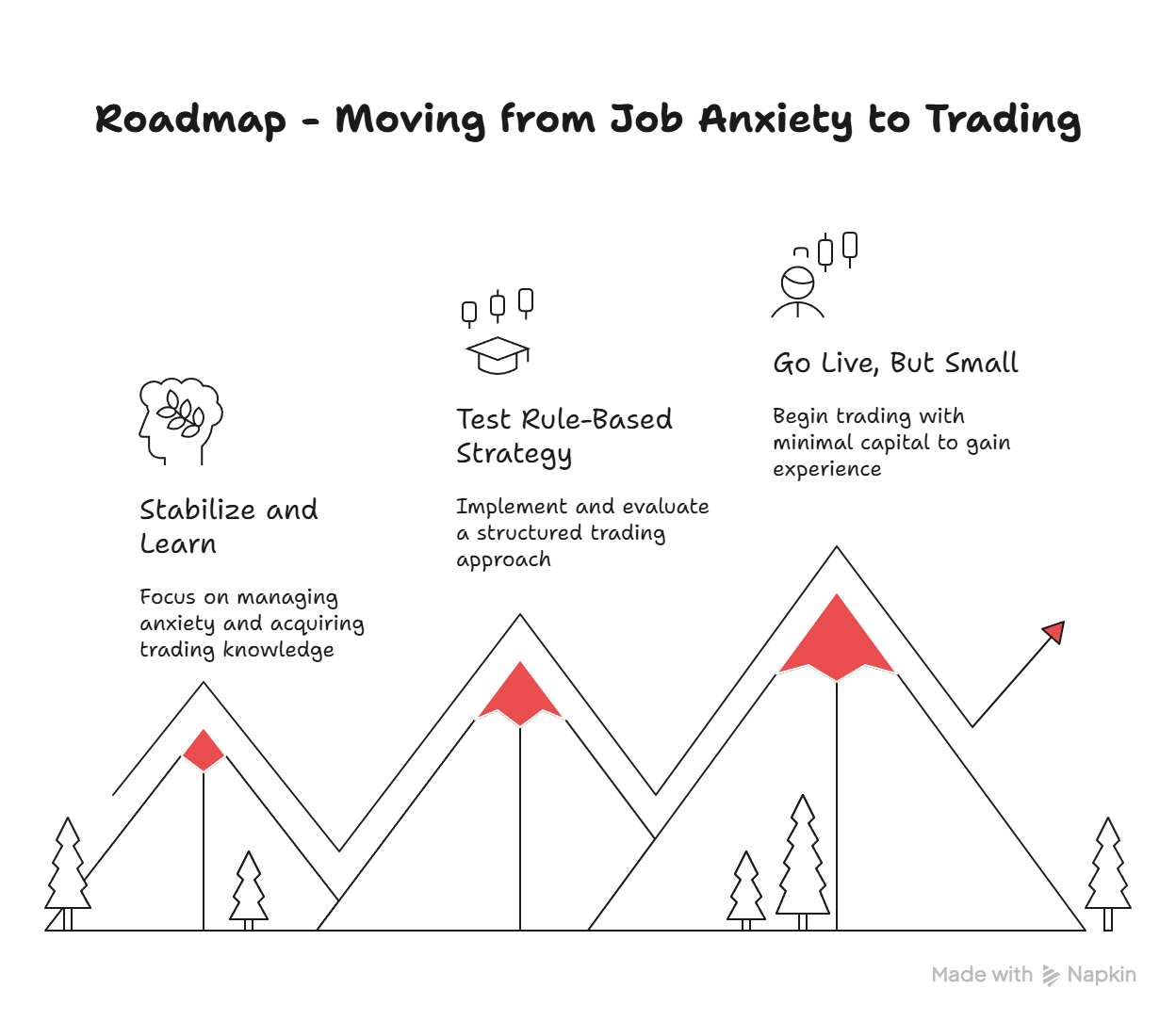
Months 0–3: Stabilize and learn
In this phase, your goal is not to make money. Your goal is to understand markets and avoid costly mistakes.
Choose one market segment. Pick one style. Study risk, position sizing, drawdowns, and journaling.
Also get clarity on your personal finances—your monthly needs, runway, and survival requirements.
Months 3–6: Test a rule-based strategy
Define a simple strategy with clear rules: entry, exit, stop-loss, and conditions.
Backtest it. Then forward test with minimal risk. Journal everything.
Consistency matters more than profits.
Months 6–12: Go live, but small
Trade with capital small enough that losses don’t affect your emotions.
Separate trading capital from essential money. Learn real execution, costs, and psychology.
12 months and beyond: Evaluate honestly
Review performance across metrics like returns, drawdowns, consistency, and emotional discipline.
Only then evaluate whether trading can become a secondary income stream.
The truth about “stable” trading income
Trading becomes stable only when the process becomes stable.
Even then, income variability will exist. That is part of the game.
This is why trading should ideally be built as a second pillar—not an immediate replacement.
Practical resources to learn trading in India
If you are serious about learning trading properly, here are some high-quality, India-relevant resources:
1. Zerodha Varsity (Free) A structured, module-based learning platform covering everything from basics to advanced topics like derivatives and risk management. Written specifically for Indian markets. A must-start resource.
2. NSE Academy / NISM Courses Formal, certification-style courses that cover market structure, compliance, derivatives, and analysis. Good for building strong foundational knowledge and credibility.
3. Get Together Finance (GTF) Focuses on practical technical analysis with real market examples. Suitable for those who prefer visual, classroom-style learning with mentorship elements.
4. IFMC Institute Offers both free and paid courses in Hindi and English. Covers technicals, intraday, and options along with exam preparation for NISM/NCFM.
5. Mahesh Chander Kaushik (YouTube) Provides grounded, low-risk trading education in Hindi with a strong focus on simplicity and practicality. Good for beginners who want a no-hype approach.
Final thought
The conversations I had with my colleagues came from a place of genuine concern. When income feels uncertain, the urge to find control is natural.
But trading should not be an emotional reaction to fear. It should be a deliberate skill you build over time.
Secure your foundation first. Learn deeply. Test honestly. Scale slowly.
Trading can become an alternate income stream—but only for those who respect the process and the risk equally.
That is the difference between hope and a plan.
More from Algo Trading
Algo Trading Cost in India: How I Built a Reliable Setup for ₹150/Month
Wondering how much algo trading costs in India? In this article, I break down the real expenses involved in running an algorithmic...
How Much Capital Do You Really Need for Sustainable Trading Income in India?
How much capital is needed for sustainable trading income in India? This in-depth guide explores the realistic returns traders can expect, the...
Build a Comprehensive Mark Minervini Screener using Python
Most stock screeners only capture fragments of what makes a true market leader. A moving average filter here, a momentum check there...