
Investing
Is the Stock Market Quietly Killing Human Creativity and productivity?

FabTrader
Article overview
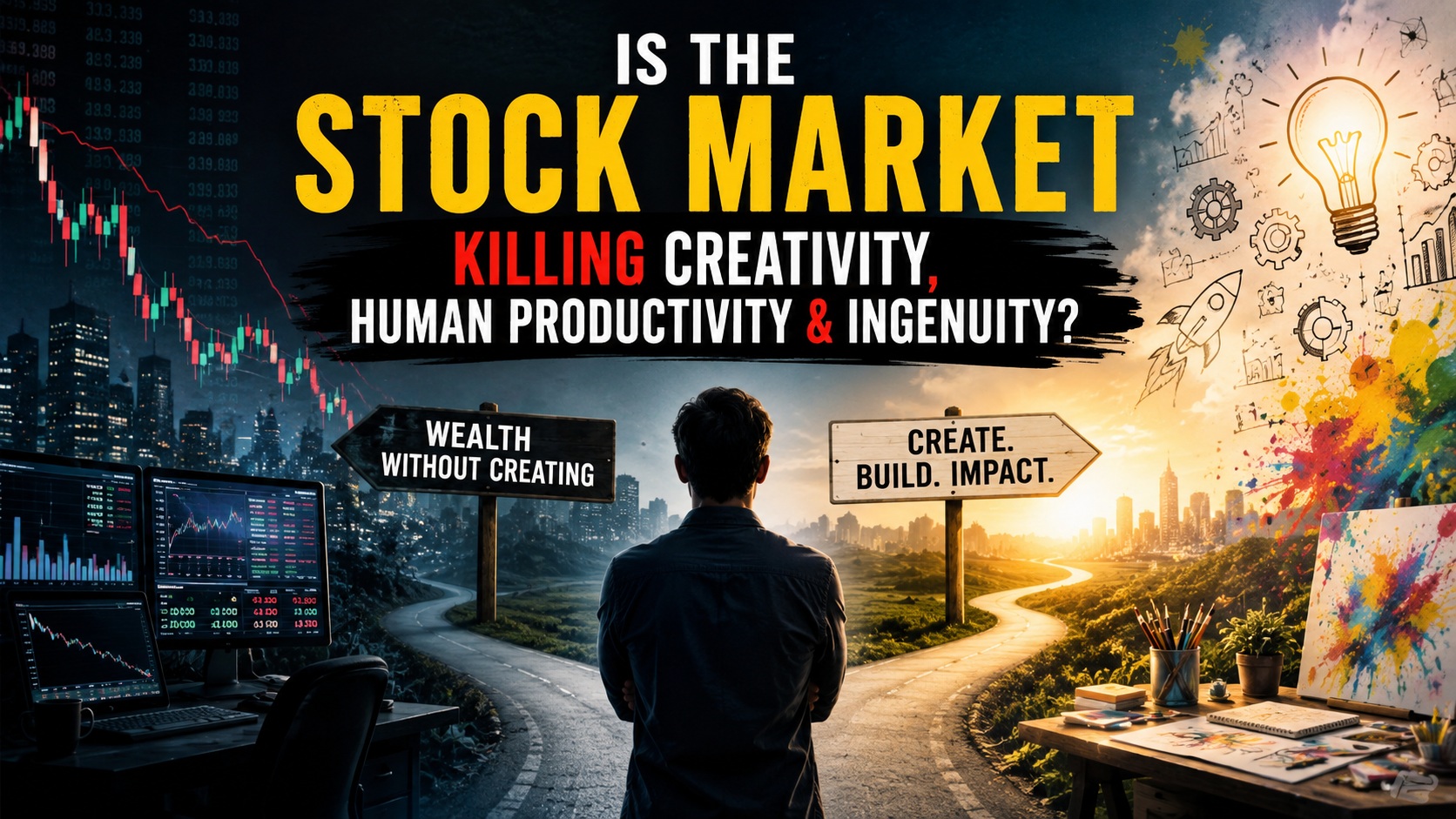
For centuries, human progress has been driven by people who built things—engineers, scientists, entrepreneurs, artists and inventors. But as financial markets become increasingly accessible and rewarding, are they quietly changing where talented people choose to spend their time and energy? After a conversation with my daughter, I found myself reflecting on my own journey and asking an uncomfortable question: Is the stock market encouraging wealth creation at the expense of human creativity, productivity and ingenuity? I don't claim to have the answer, but I believe it's a question worth thinking about.
Every once in a while, a question enters your mind that refuses to leave. It doesn't arrive dramatically, nor does it demand an immediate answer. Instead, it quietly settles somewhere in the background, resurfacing at unexpected moments until you eventually realise that perhaps it deserves to be taken seriously. This article is about one such question.
I usually write about programming, algorithmic trading, investing and personal finance. Those subjects feel familiar because they are closely tied to how I've spent much of my professional life. This time, however, I'd like to wander into territory that is a little more philosophical. There are no trading strategies here, no charts to analyse and no practical framework to apply. In fact, after reading this article, you may not find anything immediately useful in the conventional sense. What I hope you will find instead is a question worth carrying with you for a while.
A few weeks ago, my daughter was watching me work. Like most evenings, I was either analysing markets, testing strategies or reviewing trades. We ended up discussing returns from investing, and somewhere in the middle of the conversation she made an observation that caught me completely off guard.
She smiled and said, "There are people working under the hot sun every day. Some spend their lives building businesses, creating products, employing people and solving real-world problems. And then there are investors who sit comfortably at home making money from the stock market. Isn't that a waste of human potential?"
We both laughed, and I instinctively defended myself. After all, nobody reaches a stage of financial freedom without years of hard work, sacrifice and taking risks. Every successful investor has a story that began long before the first investment was made. But once the conversation ended, her question refused to leave me.
The more I thought about it, the more I realised it wasn't really about the stock market. It was about something much deeper. As financial markets become increasingly accessible and rewarding, are they quietly encouraging some of our brightest minds to allocate capital instead of creating products, building businesses or solving difficult problems? Is wealth creation gradually becoming more attractive than value creation?
I don't know the answer, and that's precisely why I wanted to write this article. What follows isn't an attempt to settle the debate. It's simply my own reflection after spending more than twenty-five years in the corporate world, trying my hand at entrepreneurship and eventually finding my calling in investing. If nothing else, I hope it leaves you thinking about a question that deserves more attention than it usually receives.
Long Before I Became an Investor
My daughter's question deserved an honest answer. After all, anyone looking at my life today could easily assume that I had somehow found an easy path to financial freedom. The reality couldn't be further from the truth.
Like many people of my generation, I spent more than twenty-five years in the corporate world. I entered the software industry during the Y2K era, grateful for an opportunity that many of my college friends never received. Coming from a lower middle-class family, I knew I couldn't afford to take that opportunity lightly. I worked relentlessly—not because someone expected me to, but because I believed that hard work was the only way to build a better life.
Twelve- and fourteen-hour workdays felt normal. Deadlines dictated weekends, personal time became a luxury and family often had to adjust around my work commitments. The corporate world rewarded me in many ways, but it also demanded a significant portion of my youth in return. Promotions didn't always come when I thought they should, salary hikes were sometimes underwhelming and there were moments of disappointment that almost everyone who has spent enough time in a large organisation will recognise. I never considered myself a victim of the system. It was simply the price that many of us paid in exchange for opportunity and financial security.
When I look back today, I don't remember those years with resentment. They taught me discipline, resilience and patience, and they funded every investment I would eventually make. More importantly, they remind me that the comfort I enjoy today wasn't gifted to me by the stock market. It was built on decades of work, sacrifice and time that I can never get back.
Perhaps that is why my daughter's question stayed with me. Having spent so many years creating value through work, was I now merely making money from money? Or was investing simply another stage in a much longer journey?
Discovering That Building Isn't the Same as Running a Business
Like many professionals who spend enough years in the corporate world, I eventually caught the entrepreneurial bug. At some point, the desire to build something of my own became too strong to ignore. I tried my hands at many things while I was still busy with my day job.
My first serious venture was in real estate. We built a few apartment projects, sold them successfully and, by most practical measures, the business did reasonably well. Yet, what stayed with me wasn't the satisfaction of completing a project—it was everything that surrounded it. Dealing with contractors, suppliers, government offices, endless approvals, bribes and the dishonesty that unfortunately exists in our system slowly took the joy out of the work itself. I enjoyed creating something tangible, but I realised that running the business required spending far more time managing problems than actually building.
Over the next few years, I started a few software ventures that showed genuine promise. We built products, attracted customers and gradually assembled teams. Watching an idea evolve into something that people were willing to use was immensely satisfying, and those remain some of the most intellectually rewarding years of my career.
As the business grows, your role gradually shifts away from creating the product itself. Increasingly, your time is spent hiring people, resolving conflicts, managing expectations, dealing with attrition, raising capital and solving operational problems that have very little to do with the original idea. None of this is unique to my experience—it's simply the reality of building any organisation. Entrepreneurship demands that you become equally comfortable with people, processes and uncertainty.
COVID eventually brought many of those plans to an abrupt halt, as it did for countless businesses around the world. Looking back now, I don't consider those ventures failures. I discovered that what I enjoyed most was not necessarily running businesses. I enjoyed solving problems. I enjoyed building systems. That realization would quietly shape the direction of the next chapter of my life.
Where I Finally Found My Craft
Throughout all these different phases of my career, one hobby remained remarkably consistent. No matter how demanding my job or business became, I always found myself returning to the markets. More often than not, it happened late at night, long after everyone else had gone to bed. Those quiet hours became my own little sanctuary. It was just me, my laptop and an endless stream of ideas waiting to be tested.
What began as a curiosity gradually became something much deeper. I found myself fascinated by the process of understanding markets, writing algorithms, backtesting strategies and trying to separate signal from noise. Every new idea was an experiment. I enjoyed the intellectual challenge far more than I enjoyed the outcome.
There was another aspect that appealed to me just as much. Markets are remarkably impartial. They don't care about titles, experience or reputation. A well-researched idea is rewarded regardless of who proposes it, while a poorly thought-out one is punished with equal indifference. That kind of honesty is rare. It forces you to remain humble because the market has an uncanny ability to expose overconfidence.
Ironically, the more successful I became as an investor, the more my daughter's question began to bother me. If this work brought me so much satisfaction and financial freedom, was it because I had finally found the right vocation? Or had I simply chosen a path where capital could do the heavy lifting while others continued creating products, building businesses and solving society's bigger problems?
12-20% return on investment in trading and investing is not uncommon, even for a passive MF investor over a period, while these are dream numbers for someone who is running a business or an employee looking for an annual salary hike. Are Traders and Investors having it easy? The allegation is that they dont seem to posses greater skills or contribute to the wider national interests and initiatives, do not build anything worthwhile and ultimately, killing the spirit of entreprenuership, creativity and real human ingenuity which has been the corner stone of all inventions and discoveries?
The more I thought about it, the less certain I became.
So, Is the Stock Market Quietly Killing Creativity?
The more I reflected on my daughter's question, the more I realised that there isn't an obvious answer.
On one hand, the argument is difficult to dismiss. If a talented engineer can earn more by managing a portfolio than by building a product, or if an entrepreneur eventually decides that investing is a more rewarding use of time than creating a business, isn't society losing something valuable? Every company that wasn't started, every invention that wasn't pursued and every idea that never left the drawing board represents a loss that we can never measure.
History has always moved forward because people chose to build. Engineers built bridges, scientists discovered medicines, entrepreneurs created businesses and artists enriched our lives in ways that money alone never could. These are the people who push civilisation forward, often with years of uncertainty and sacrifice before anyone recognises their contribution.
Perhaps the real issue isn't whether investing creates value, but whether it becomes the destination too early. If young people begin chasing the markets before they have first built skills, solved problems or contributed meaningfully through their own work, we risk producing a generation that wants the rewards of wealth before experiencing the satisfaction of creating something worthwhile.
That, I believe, is a far more important question than whether investing itself is good or bad. Personally, however, I don't find this argument particularly troubling. Not because I dismiss it, but because I genuinely feel I have given my best at every stage of my life. Whether it was my years in the corporate world, my entrepreneurial ventures or my journey into investing, I immersed myself fully and tried to contribute to the best of my ability. I may not have changed the world, but I have never felt that I took the easy path.
A Question Worth Thinking About
The older I get, the more comfortable I have become with not having definitive answers to every difficult question. Earlier in my career, I always felt compelled to arrive at a conclusion. If I didn't understand something, I would read more, analyse more and keep searching until I found an explanation that satisfied me. This question has been different.
I can see the merit in both arguments. There is no doubt that societies progress because people choose to build—whether they build businesses, technologies, medicines or works of art. We should never lose sight of the value that creators bring to the world. At the same time, I don't think investing is merely about making money from money. Healthy capital markets are an essential part of every growing economy, and thoughtful investors play an important role in directing capital towards businesses that deserve it.
Perhaps the distinction lies elsewhere. Investing should not become a substitute for developing skills, creating value or doing meaningful work. It should be a consequence of those things. In my own case, the stock market did not replace work—it was built on top of decades of work.
Today, I spend more of my time investing than I do running businesses, but I don't see that as an escape from contributing. If anything, it has given me the freedom to write, build software, share ideas and spend time with this community. Those may not be inventions that change the course of history, but they are my way of continuing to create.
So, is the stock market quietly killing creativity? I honestly don't know.
I'd love to hear what you think. Is investing simply another form of creation, or does it tempt too many talented people away from building things the world genuinely needs? I don't have the answer, and that's precisely why I felt this question was worth sharing with you.
More from Investing
Beyond Returns: Why I Built a More Intelligent Midcap Mutual Fund Screener
Looking for the best midcap mutual funds in India? This article explains how our Midcap Mutual Fund Screener goes beyond traditional return-based...
How to Build a robust Passive Index Investing System that works
Passive investing has transformed the way investors build wealth. But with so many choices—from Nifty 50 Index Funds and Nifty Next 50...
A Simple, Peaceful ETF Rotation Strategy That Delivered 32% CAGR
Markets are constantly shifting leadership between sectors, asset classes, and global markets. Instead of trying to predict where the next opportunity might...