
Investing
“Bull or Bear, Real Investors don't care : The Friend who stopped SIP

FabTrader
Article overview
Each time a major sale festival hits—Amazon’s Great Indian Festival, Flipkart’s Big Billion Days—I see the same pattern. Phones, clothes, electronics fly off shelves. People boast of “saving ₹7,000 here, ₹3,000 there.” Amid this frenzy, I messaged one friend I’d once guided to start a SIP in mutual funds - just wanted...
Each time a major sale festival hits—Amazon’s Great Indian Festival, Flipkart’s Big Billion Days—I see the same pattern. Phones, clothes, electronics fly off shelves. People boast of “saving ₹7,000 here, ₹3,000 there.” Amid this frenzy, I messaged one friend I’d once guided to start a SIP in mutual funds - just wanted to see how he was doing? He replied with a shrug: “I’ve paused the SIPs — the markets have been flat for months.”
That moment lingered with me. Think about it: this is the same person who would spend hours hunting for ₹500 discounts on gadgets, yet won’t touch equities when they’ve pulled back 10–20%. The paradox was striking: the willingness to shop smartly versus the reluctance to invest wisely.
In conversations with fellow investors, I often hear these refrains:
- “The market is at an all-time high. I’ll wait for a dip.”
- “It’s too volatile right now.”
- “It’s a bear market; I’ll invest when it recovers.”
- "Market is sideways, only fools invest now"
The irony? These same investors don’t wait for the next “sale” to buy gadgets, but hesitate when the stock market offers the real sale — when high-quality businesses are trading at discounts. It makes one wonder sometimes, may be people are looking for an excuse NOT to invest!
Markets don’t reward perfect nerves — they reward participation
Over time, I’ve come to see bull and bear phases as seasons—not signals to hibernate or sprint—but moments to calibrate. And the best investors? They don’t fret about the season; they care about being in the game.
The Market Is Always in Season
A seasoned investor sees market cycles the way a farmer sees weather: each season has its role.
- In bull markets, your assets appreciates in price, portfolio flourishes,
- In bear markets, your money buys more units, seeding future growth.
The smartest investors understand this rhythm and build strategies around it, not against it. Take September 2023 as a reminder. The NIFTY 50 hit a then-record 20,192. Many paused their SIPs, certain that the “top” was in. Fast forward to September 2024: NIFTY crossed 26,250, a 30% surge in a year.
Every “all-time high” simply becomes another milestone on the market’s long-term upward trajectory. Since its inception, NIFTY has grown from 1,000 in 1995 to over 25,000 in 2025 — a 25x rise in 30 years, translating to roughly 11% CAGR. That’s the quiet magic of compounding — it rewards time, not timing.
The Numbers Don’t Lie
Let’s look at what decades of data and research have shown.
1. The Schwab Market Timing Study (1970–2022)
Charles Schwab conducted a fascinating 50-year study comparing five investors who each received $2,000 annually:
Even the worst timer — the one who always bought at the peak — ended up with nearly 80% of the wealth of the perfect timer. The difference between perfect timing and terrible timing is far smaller than the cost of not investing at all.
The lesson: Being consistently in the market beats being occasionally right.
2. Fidelity’s “Peter Lynch Effect”
Peter Lynch, the legendary manager of Fidelity Magellan Fund (1977–1990), generated 29% annual returns, turning $10,000 into over $280,000. Yet Fidelity discovered something ironic: many investors in the fund lost money.
Why? Because they kept pulling money out during downturns and reinvesting when things looked rosy — buying high, selling low. The fund did its job; the investors didn’t.
Lynch famously said:
“Far more money has been lost by investors preparing for corrections than in the corrections themselves.”
3. Nifty 50 SIP Case Study (2000–2025)
Let’s bring this home. Suppose someone started a ₹10,000 monthly SIP in Nifty 50 in January 2000.
- Total Invested: ₹30,00,000
- Portfolio Value (Jan 2025): ₹1.27 crore
- CAGR: ~10.9%
Now imagine the worst-case scenario: the investor only bought when Nifty hit its annual peak each year. Even then, their corpus would be worth ₹75–80 lakh — more than 2.5x their total investment.
So yes, even the “unluckiest” investor — one who always bought at market highs — still ended up wealthy.
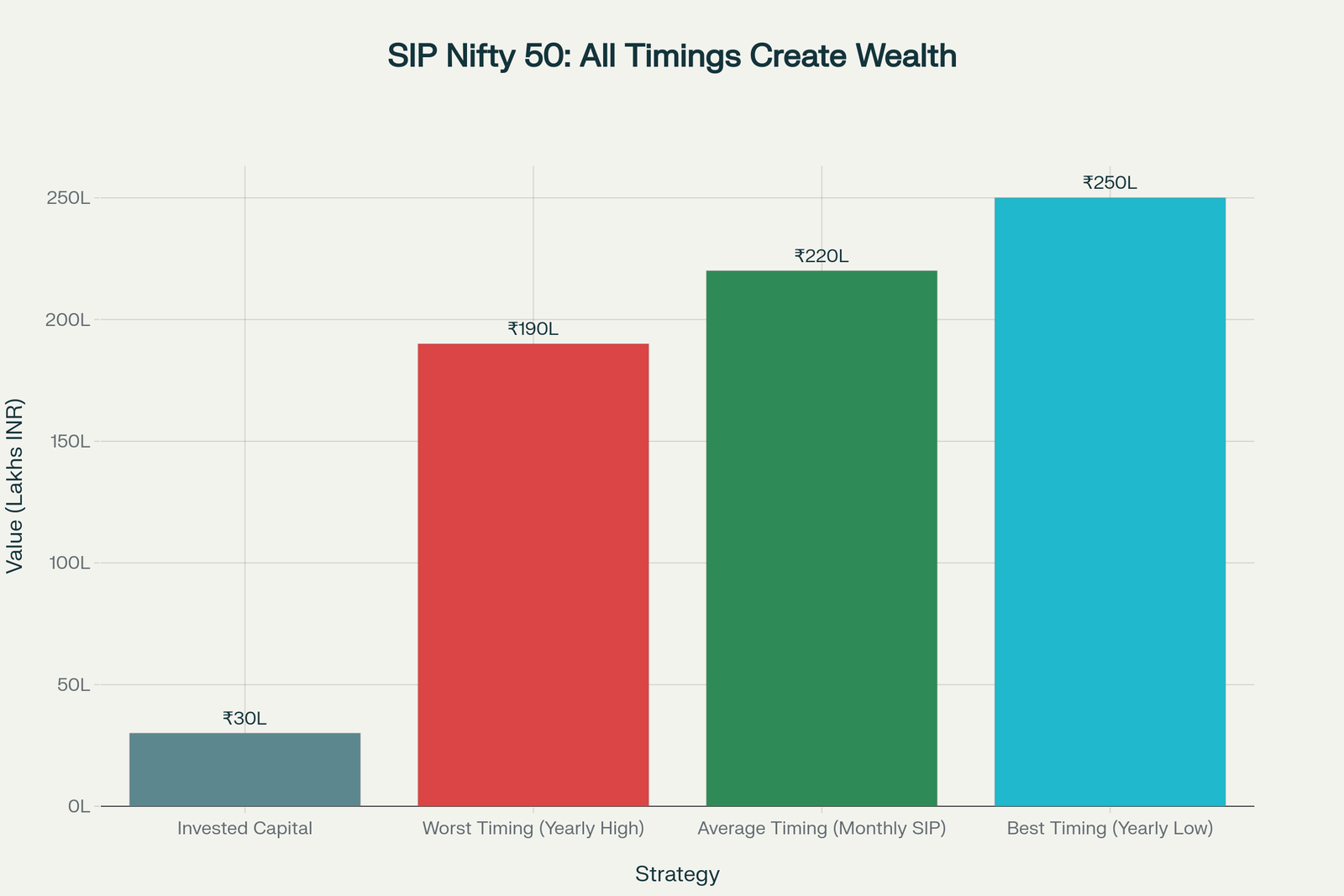
Note : This visual compares final portfolio outcomes for three SIP strategies in the Nifty 50 from 2000 to 2025: best timing (buying at yearly lows), worst timing (buying at yearly highs), and disciplined monthly SIP purchases. Even the worst-timed SIP results in significant wealth creation, demonstrating that market timing barely affects long-term outcomes compared to consistency.
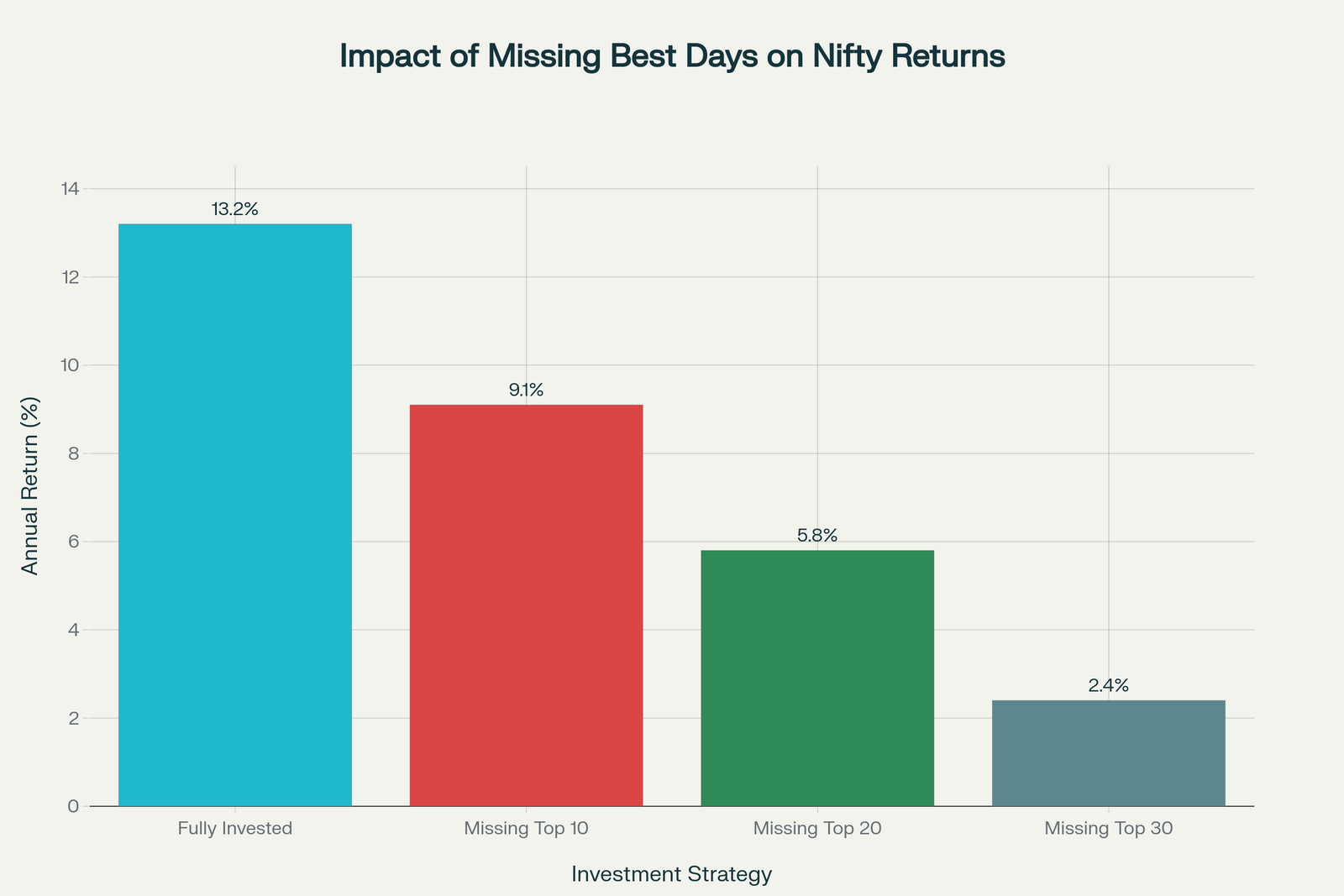
Note: This striking chart showcases how missing just the 10, 20, or 30 best days in the Nifty 50 since 2000 slashes final returns by as much as half or more compared to staying fully invested. The message: the biggest gains often cluster near big downturns, so timing the market is riskier than remaining invested.
The Real Cost of “Waiting for the Dip”
Market timers often miss out on the most powerful days for returns. JPMorgan Asset Management’s 2023 analysis found:
- Missing just the 10 best trading days in 20 years (2003–2023) slashed total returns by over 50%.
- The best days typically occurred within 2 weeks of the worst days.
That means if you sold during volatility, you probably missed the recovery too.
Here’s how ₹10 lakh invested in the Nifty 50 (2003–2023) would have fared:
Trying to sidestep short-term pain often costs long-term wealth.
Recent Example – The COVID Crash
On March 23, 2020, the Nifty 50 hit 7,610, down over 35% from its January peak. Panic selling was rampant. By April 2021, Nifty had rebounded above 14,500, a 90% gain in just 12 months. Those who stopped SIPs or redeemed funds in March 2020 missed one of the fastest recoveries in history. Investors who simply did nothing — who stayed invested — were rewarded handsomely.
Why We Struggle With Market Cycles
Behavioral finance has plenty to say here. Nobel laureate Daniel Kahneman showed that humans feel losses twice as intensely as gains — a bias called loss aversion.
When the market dips 10%, the emotional pain feels like a 20% hit. That’s why people sell, even when they know, rationally, that corrections are normal.
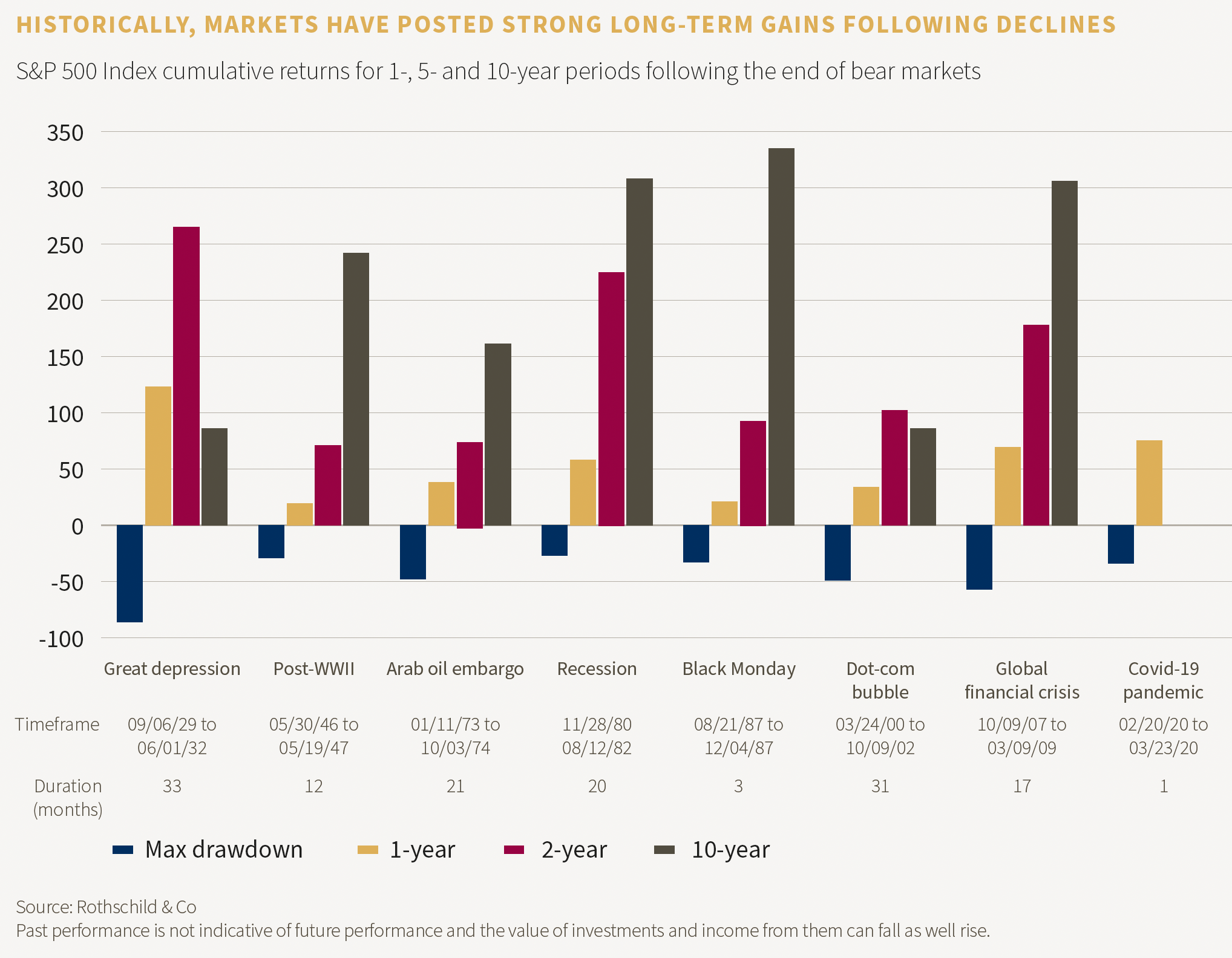
Yet every crash has been temporary, and every recovery has set new highs. From the Harshad Mehta crash (1992) to the Global Financial Crisis (2008) to COVID (2020) — the market has always rewarded those who stayed patient.
The Indian Context
According to AMFI data (as of 2025):
- SIP inflows in India now exceed ₹20,000 crore/month — a 5x jump since 2017.
- The average SIP investor who stayed invested for 10+ years has earned between 10–14% CAGR.
Despite short-term volatility, Indian equity mutual funds have compounded investor wealth nearly 20x in the last two decades. As India’s GDP continues to grow at 6–7%, and corporate earnings mirror that trajectory, long-term equity returns are likely to remain resilient.
The Mindset That Wins
Real investors think like owners, not traders. They:
- See corrections as sales on long-term wealth.
- Focus on time horizons, not headlines.
- Automate investments through SIPs, insulating themselves from emotions.
The right question isn’t “Is it the right time to invest?” but “Am I consistent enough to let time do its magic?”
In the End: Seasons Change, Compounding Doesn’t
Bull or bear, markets will keep cycling — up, down, sideways — but the investor who keeps investing, keeps growing.
The real edge in investing isn’t predicting seasons. It’s planting seeds relentlessly and nurturing it.
More from Investing
Is the Stock Market Quietly Killing Human Creativity and productivity?
For centuries, human progress has been driven by people who built things—engineers, scientists, entrepreneurs, artists and inventors. But as financial markets become...
Beyond Returns: Why I Built a More Intelligent Midcap Mutual Fund Screener
Looking for the best midcap mutual funds in India? This article explains how our Midcap Mutual Fund Screener goes beyond traditional return-based...
How to Build a robust Passive Index Investing System that works
Passive investing has transformed the way investors build wealth. But with so many choices—from Nifty 50 Index Funds and Nifty Next 50...