
Investing
Goal Planning: The Simple Process Most Investors Get Wrong

FabTrader
Article overview
Investing isn't about choosing the best mutual fund or ETF—it's about having the right financial plan. Learn how to do goal planning the right way by estimating future costs, accounting for goal-specific inflation, choosing the right asset allocation, prioritizing multiple financial goals, and building a realistic investment roadmap. Includes a free online Goal Planning Calculator for Indian investors.
Every week, I receive messages from members of the FabTrader community asking questions about investments. The questions are usually different on the surface but remarkably similar underneath. Someone wants to know which mutual fund they should choose. Another wants to invest in an ETF but is unsure which one is suitable. Someone else wonders whether silver has more upside than gold, while another asks if a recent fall in Bitcoin prices makes it a buying opportunity.
There is nothing wrong with any of these questions. In fact, they are exactly the kinds of questions that most investors ask. The problem is that they are being asked far too early in the decision-making process.
When we begin with investment products, we are implicitly assuming that choosing the right product is the most important part of investing. I don't think it is. In my experience, product selection is one of the last decisions an investor should make. Before deciding where to invest, we should first understand why we are investing. Without that context, it is impossible to judge whether a mutual fund, ETF, fixed deposit or even a simple recurring deposit is appropriate. The same investment can be an excellent choice for one goal and a poor choice for another.
Over the years, I have realised that successful investing has much less to do with finding the perfect product and much more to do with building the right process. Once the process is clear, choosing products becomes relatively straightforward. Unfortunately, most investors reverse the order. They spend weeks researching funds, comparing historical returns and worrying about expense ratios, while spending very little time defining the financial goals those investments are meant to achieve.
That, in my opinion, is where most financial planning begins to drift off course.

Goal Planning Isn't New. Good Goal Planning Is Surprisingly Rare.
Goal planning has been around for decades. Every financial advisor recommends it, every investment platform has a retirement calculator, and there are countless articles explaining why you should invest for your goals instead of chasing returns. So, if goal planning is such a well-established concept, why do so many people still struggle to achieve their financial goals? I think the answer lies in how goal planning is usually done.
Most goal plans are built using assumptions that are convenient rather than realistic. A single inflation rate is applied to every goal, irrespective of whether it is retirement, higher education or buying a house. One expected investment return is assumed for every time horizon. Asset allocation rarely changes with the nature of the goal. In many cases, each goal is planned independently, as though retirement, children's education and buying a home have nothing to do with each other.
Real life doesn't work that way. Every financial goal competes for the same monthly savings. Choosing to invest more towards one goal automatically means investing less towards another. The challenge isn't calculating one SIP for one goal. The real challenge is fitting all your goals into a single financial plan that is both realistic and affordable.
Good goal planning, therefore, is much more than estimating a future value and starting a monthly investment. It is about making sensible assumptions, understanding the role of risk, recognising that different goals deserve different investment strategies, and periodically reviewing the plan as life changes.
In my experience, this is where most investors go wrong. Not because they lack discipline or don't save enough, but because the planning process itself is often too simplistic. A well-designed plan should reflect how money behaves in the real world—not just how a spreadsheet performs a calculation. That is precisely what this article is about.
Every Financial Goal Begins with One Simple Question: Why?
Whenever someone asks me where they should invest, I often respond with another question. "What are you investing for?"
At first, it feels like an unnecessary question. After all, if someone has ₹20,000 to invest every month, shouldn't the discussion begin with mutual funds, ETFs or stocks? I don't think so. The purpose behind an investment determines almost every decision that follows. Without knowing why the money is being invested, it is impossible to decide how much risk should be taken, what investment horizon is appropriate, or even whether equity is the right asset class.
Take two investors who are considering the very same index fund. One is saving for a home down payment four years from now. The other is building a retirement corpus that will not be touched for another twenty-five years. The investment product is identical, but its suitability is completely different because the purpose is different. This is why I believe that the "Why" is far more important than the "Where."
Interestingly, many people struggle to answer this question. A common response is, "I just want to create wealth." While that sounds reasonable, it isn't really a financial goal. Wealth, by itself, is not an end objective. It is simply a resource that helps you achieve something else. The real question is: what will that wealth eventually be used for?
For most people, the answers are surprisingly predictable. Retirement, buying a home, children's education, building an emergency fund, starting a business, planning a major vacation or creating financial security for the family. These are tangible goals with a purpose, a timeline and a cost.
In fact, I often say that retirement is the one financial goal almost everyone has, whether they acknowledge it or not. You may choose not to buy a larger house. You may decide not to fund your child's overseas education. You may never own a luxury car. Those are personal choices. But one day, your regular income from work will stop, while your expenses are likely to continue for several decades. Planning for that transition is not optional.
Once the purpose becomes clear, the rest of the planning process starts falling into place. You can estimate how much the goal costs today, project what it might cost in the future, decide how much investment risk is appropriate, and calculate how much you need to save every month. Notice how the investment product still hasn't entered the conversation. That is exactly how I believe financial planning should work.
Too often, investors spend hours comparing mutual funds that differ by a fraction of a percentage point in annual returns, while spending almost no time defining the objective those investments are supposed to achieve. In reality, a clearly defined goal will have a far greater impact on long-term success than choosing between two equally good investment products. The investment is merely the vehicle. The goal is the destination. And just as you wouldn't choose a vehicle before deciding where you want to travel, it makes little sense to choose an investment before deciding what financial journey you are trying to undertake.
Understanding the real cost of your financial goal
One of the first questions I ask while planning a financial goal is deceptively simple: "What would this goal cost if you had to pay for it today?" Most people can answer that question reasonably well. They know roughly how much a house down payment, a child's college education or a new car would cost today. The problem is that we almost never need the money today.
If your daughter is five years old, her college education may still be fifteen years away. If you're thirty-five, retirement may be another twenty-five years away. A dream vacation might happen five years from now. The numbers you see today are merely starting points. What really matters is what those goals are likely to cost when you actually need the money. This is where inflation quietly becomes one of the most important assumptions in financial planning. Most online calculators ask for an inflation rate and many investors simply enter 6% because it is the number they have seen most often. While there is nothing magical about 6%, it has somehow become the default assumption for almost every financial goal.
I have never been comfortable with that approach. Different goals experience inflation differently. College fees don't increase at the same pace as the cost of buying a car. Medical expenses have their own inflation cycle. Property prices behave differently from travel costs, and retirement isn't even a one-time expense—it is a stream of expenses spread over several decades. Using a single inflation assumption for every goal certainly makes calculations easier, but it doesn't necessarily make them more realistic. Suppose higher education costs ₹20 lakh today. If education inflation averages 9% over the next fifteen years instead of 6%, the difference in the final amount required isn't marginal—it could easily run into several lakhs. That shortfall doesn't arise because your investments performed poorly. It arises because the planning itself began with an unrealistic assumption.
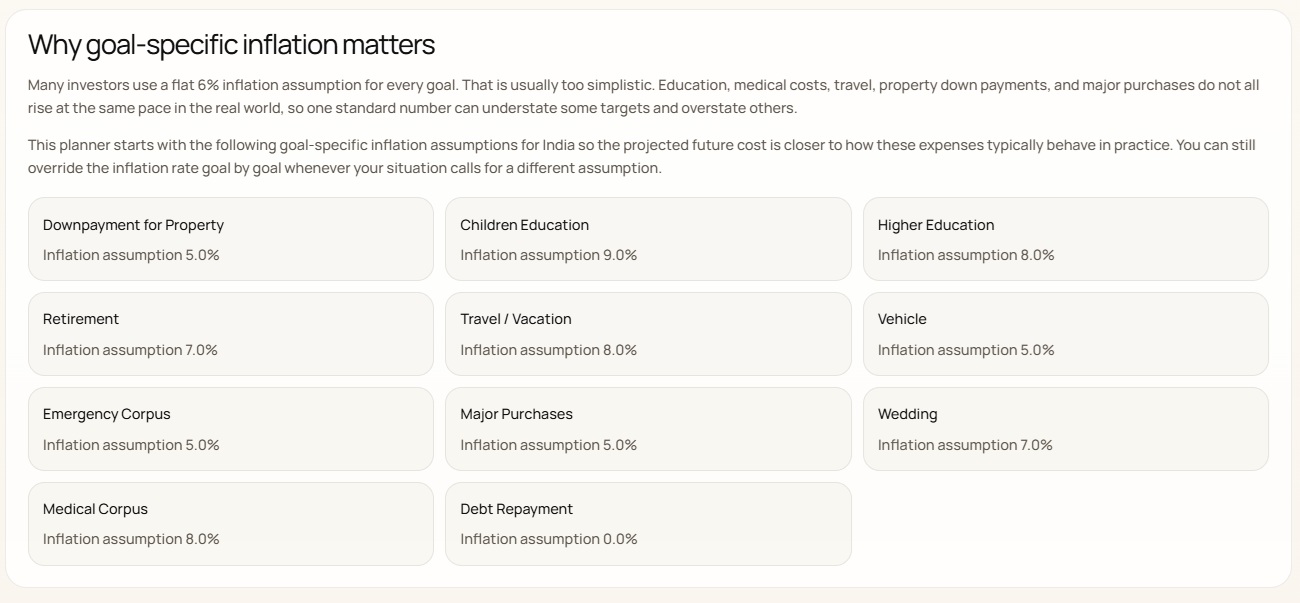
This is why I prefer to think about goal-specific inflation rather than a universal inflation rate. Retirement, education, healthcare, travel and property are fundamentally different goals, so there is no reason to assume they should all inflate at exactly the same pace. Of course, nobody knows what inflation will actually be over the next ten or twenty years. These are assumptions, not predictions. But financial planning isn't about predicting the future perfectly. It is about making assumptions that are reasonable enough to improve the quality of your decisions.
Once you estimate the future cost of a goal, something interesting happens. The conversation shifts. You stop asking, "How can I earn the highest return?" and start asking, "How can I accumulate this amount with the highest probability of success?" That is a far better question. Because at the end of the day, your objective isn't to beat inflation or outperform the market. Your objective is much simpler. It is to have enough money available when the goal arrives. Everything else is secondary.
Every Goal Doesn't Deserve the Same Investment Strategy
Once you know why you are investing and how much you need in the future, the next temptation is to look for investments that can generate the highest possible return. I think this is where many investors take a wrong turn.The objective of investing isn't to maximise returns. The objective is to maximise the probability of achieving your goal. Those are two very different things.
Imagine you need the money for a home down payment three years from now. Would you invest the entire amount in equity simply because equities have historically delivered higher returns over long periods? Probably not. The market doesn't know that your home purchase is only three years away. If it happens to go through a prolonged correction just before you need the money, your plans may have to be postponed. Now consider a retirement goal that is still twenty-five years away. In this case, avoiding equity altogether could be equally damaging. Over such long periods, inflation becomes a much bigger risk than market volatility, and growth-oriented assets have a much greater role to play.
The investment product hasn't changed. What has changed is the time available for the investment to recover from uncertainty. This is why I believe that time horizon should drive asset allocation. A near-term goal requires stability. A long-term goal requires growth. Goals that fall somewhere in between usually need a balance of both. Unfortunately, many investors build a single portfolio and expect it to serve every purpose. The same mutual funds are expected to fund retirement, children's education, a home purchase and an emergency fund. While this may appear simple, it ignores the fact that each of these goals has a different time horizon and a different capacity to tolerate risk.
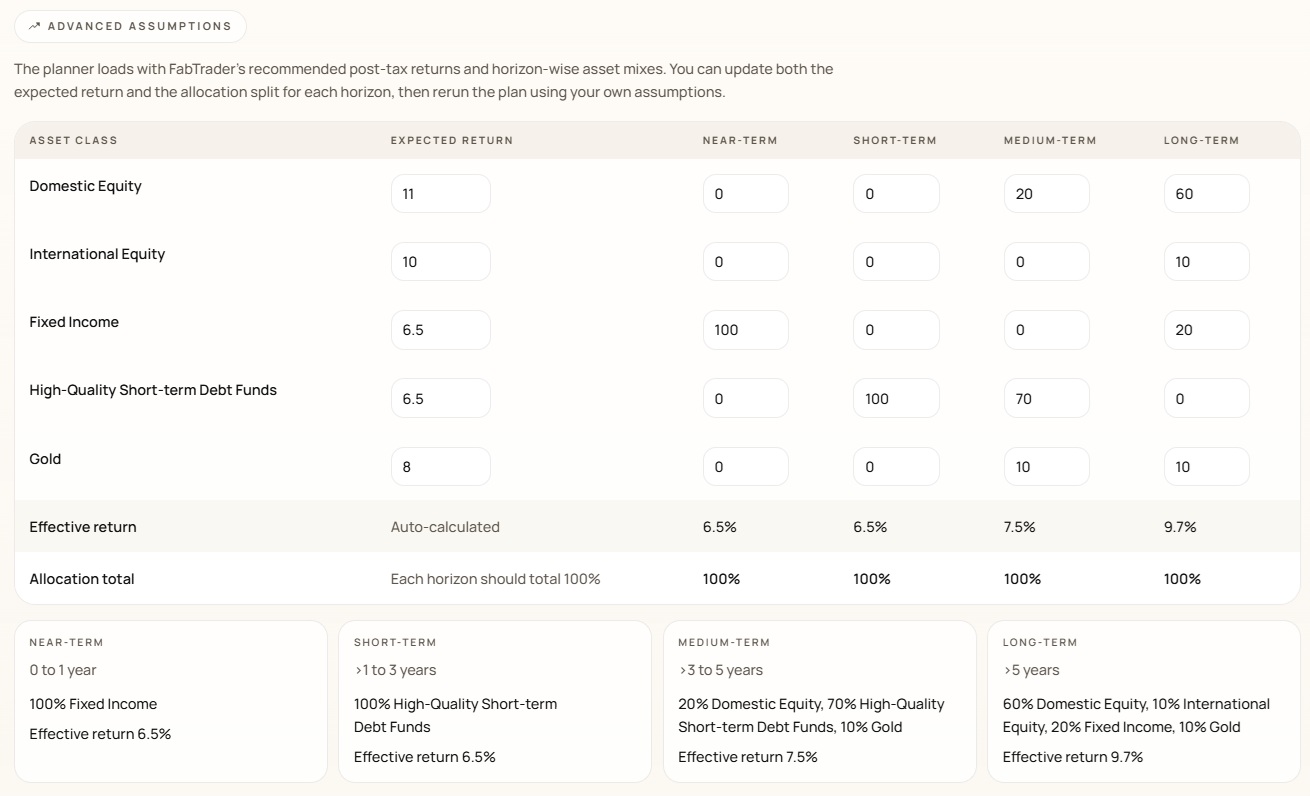
A better approach is to let the goal determine the investment strategy. For goals that are only a year or two away, preserving capital is often more important than chasing returns. For medium-term goals, a balanced allocation may make sense. For goals that are more than a decade away, equity can reasonably play a much larger role because time allows the portfolio to ride through market cycles. Notice that we still haven't discussed specific mutual funds or ETFs. That's deliberate.
Asset allocation is one of the most important decisions an investor will make. Product selection comes much later. In fact, once you have decided how much equity, fixed income or gold a goal requires, choosing the actual investment products becomes a relatively straightforward exercise. I often find that investors spend days comparing one index fund with another while spending only a few minutes thinking about whether their overall asset allocation is appropriate. In reality, getting the asset allocation broadly right will usually have a far greater impact on long-term outcomes than choosing between two well-managed investment products within the same category. The process, once again, comes before the product.
The Biggest Mistake Most Goal Planners Make: Planning One Goal at a Time
Most financial calculators are designed to answer a very specific question.
- How much should I invest for retirement?
- How much should I save for my child's education?
- How much do I need for a house down payment?
Viewed individually, each of these calculators does its job reasonably well. You enter a few assumptions, adjust the numbers until you're satisfied, and the calculator tells you the monthly investment required for that particular goal. The problem is that life doesn't happen one goal at a time. A young family may simultaneously be planning for a home purchase, their children's education, retirement, an emergency corpus and perhaps a dream vacation every few years. Someone in their forties may be supporting ageing parents while saving for retirement and helping their children through college. Even if each of these goals is planned perfectly in isolation, they all compete for one scarce resource—your monthly surplus.
That is the part most calculators ignore. Let's assume your retirement calculator tells you to invest ₹25,000 every month. An education planner suggests another ₹15,000. A house planner recommends ₹30,000. Add a vacation fund, a vehicle replacement fund and an emergency corpus, and suddenly your monthly investment requirement has crossed ₹80,000. Individually, every recommendation may be mathematically correct. Collectively, they may be completely unrealistic. Financial planning isn't just about calculating how much one goal requires. It is about deciding how all your goals fit together within the limits of your income. This is where prioritisation becomes far more important than calculation.
Some goals are non-negotiable. Retirement is one of them. Building an emergency fund is another. Other goals may be flexible. You might postpone buying a larger house, delay an overseas vacation by a couple of years or choose a more modest wedding budget. These aren't mathematical decisions; they're life decisions. But they can only be made when you see your financial picture as a whole rather than as a collection of independent calculations.
I believe this is one of the biggest mindset shifts investors need to make. Instead of asking, "How much should I invest for this goal?", a much better question is: "Given everything I want to achieve over the next twenty or thirty years, what is the most sensible way to allocate my monthly savings?" That question acknowledges an important reality: every financial decision involves trade-offs. Increasing your retirement contribution today may delay your home purchase. Buying a larger house could reduce the amount available for your children's education. Choosing early retirement may require you to postpone discretionary goals for a few years. None of these decisions are right or wrong—they simply reflect your priorities.
A good financial plan should make those trade-offs visible. Because once you can see the complete picture, your decisions become more deliberate. You're no longer reacting to individual goals as they arise. Instead, you're building a roadmap that reflects your priorities, your cash flows and the life you want to create over the next several decades. In my experience, this holistic view is what separates financial planning from financial calculation. Anyone can calculate a SIP. Planning is about understanding how every goal interacts with every other goal.
Bringing It All Together: A Practical Framework for Goal Planning
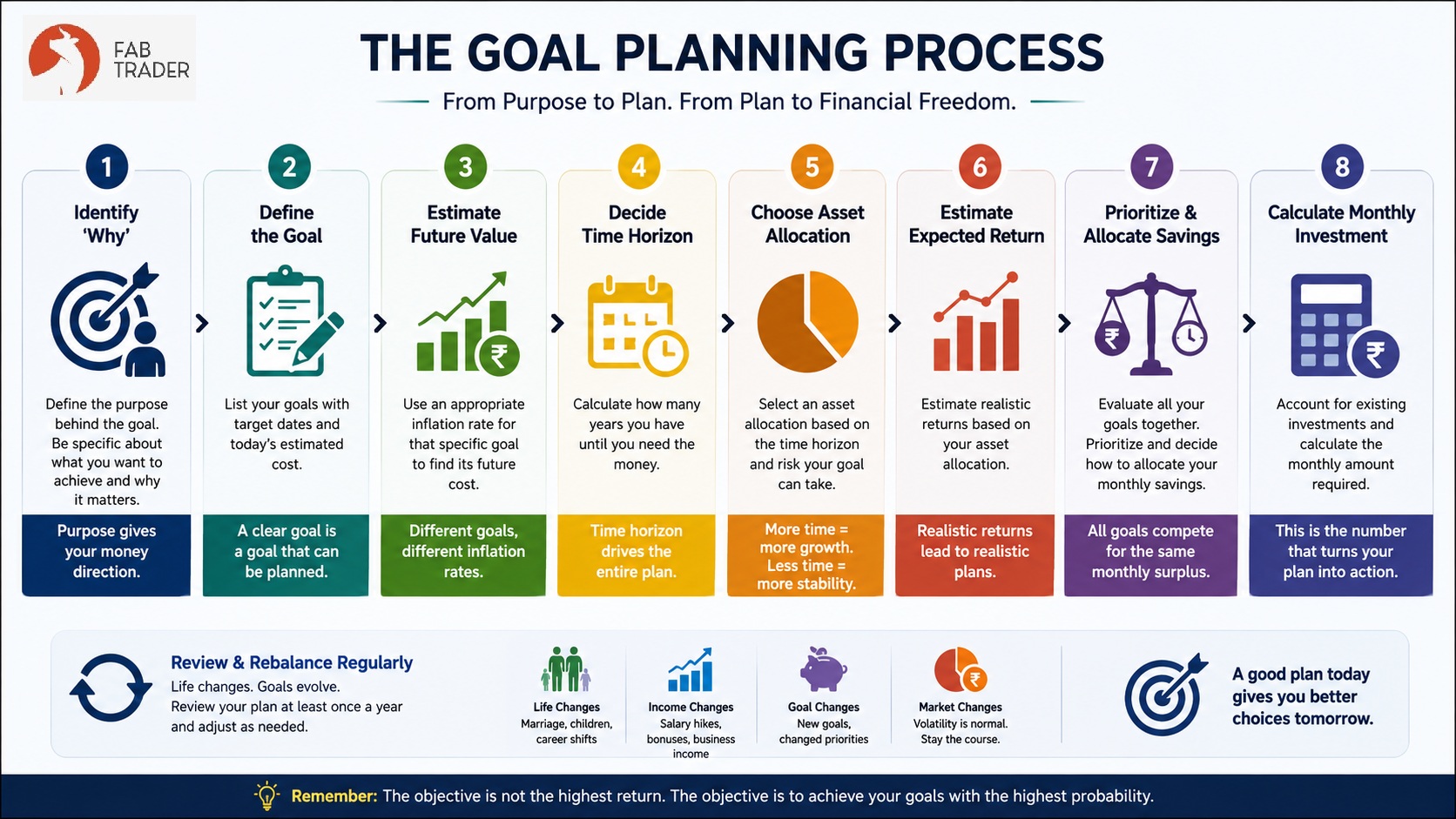
By now, one thing should be reasonably clear. Good goal planning is not about finding the best mutual fund or chasing the highest possible return. It is about building a process that gives you the highest probability of achieving your financial goals. Fortunately, that process is not as complicated as it may initially seem. In fact, every financial goal can be planned using the same broad framework. The assumptions may differ, but the sequence of thinking remains remarkably consistent. The journey begins by defining the goal itself. This may sound obvious, but vague objectives such as "I want to create wealth" or "I want to become financially secure" are difficult to plan for. A good financial goal is specific. It has a purpose, an approximate target date and a present-day cost. Whether the goal is retirement, buying a house or funding a child's education, the more clearly it is defined, the easier it becomes to build a meaningful plan around it.
The next step is to estimate what that goal is likely to cost when the money is actually required. This is where inflation plays its role. Rather than assuming that every goal will experience identical inflation, it is worth thinking about the nature of the expense itself. Education, healthcare, property and retirement expenses often behave very differently over long periods. The objective isn't to predict inflation with perfect accuracy, but to make assumptions that are sensible enough to avoid unpleasant surprises later. Once the future cost is estimated, attention shifts towards the investment strategy. Here, the most important question is not "Which mutual fund should I buy?" but "How much risk can this goal afford to take?" A goal that is twenty years away has the luxury of time and can tolerate short-term market volatility. A goal that is only a few years away cannot. As the investment horizon changes, so should the asset allocation. Growth becomes more important for long-term goals, while stability becomes increasingly valuable as the goal approaches.
Only after these pieces are in place does it make sense to estimate the expected return of the portfolio. Notice the order of decisions. The expected return is not an input chosen in isolation. It is a consequence of the asset allocation you have selected. A portfolio with a higher allocation to equity may reasonably be expected to deliver higher long-term returns, but it also comes with greater uncertainty. Every return assumption should therefore reflect the level of risk you are willing to accept rather than an optimistic expectation of what markets might deliver.
The final step is simply mathematics. Once the future cost, investment horizon, expected returns and any existing investments are known, it becomes possible to calculate the monthly investment required to bridge the gap. This is the number that most calculators display, but in reality it is the outcome of every decision that came before it. Change any one of those assumptions and the required monthly investment changes as well. Perhaps the most important thing to remember is that a financial plan is never permanent. Promotions happen. Careers change. Families grow. Goals evolve. Markets surprise us. A plan that was perfectly reasonable five years ago may need to be adjusted today. That isn't a sign that the original plan failed. It simply reflects the fact that financial planning is a continuous process rather than a one-time exercise.
Viewed this way, goal planning stops being a calculator that you visit once and forget about. Instead, it becomes a framework for making better financial decisions throughout your life. The calculations are important, but they are only one part of the process. The real value lies in the thinking that happens before the calculator produces its final answer.
Why I Built the FabTrader Goal Planner
The idea behind the FabTrader Goal Planner didn't begin with a desire to build another financial calculator. The internet already has hundreds of them, and many do a perfectly good job of solving individual problems. You can find separate calculators for retirement, SIPs, children's education, inflation, or financial independence within a matter of minutes. The challenge wasn't the lack of calculators. The challenge was that they rarely spoke to each other.
Over the years, while interacting with members of the FabTrader community, I noticed that most people weren't struggling with mathematics. They were struggling with decision-making. They wanted to know whether they were saving enough, whether their goals were realistic, and how to balance competing priorities. Unfortunately, answering those questions meant jumping between multiple spreadsheets and calculators, manually stitching together the results and hoping nothing had been overlooked.
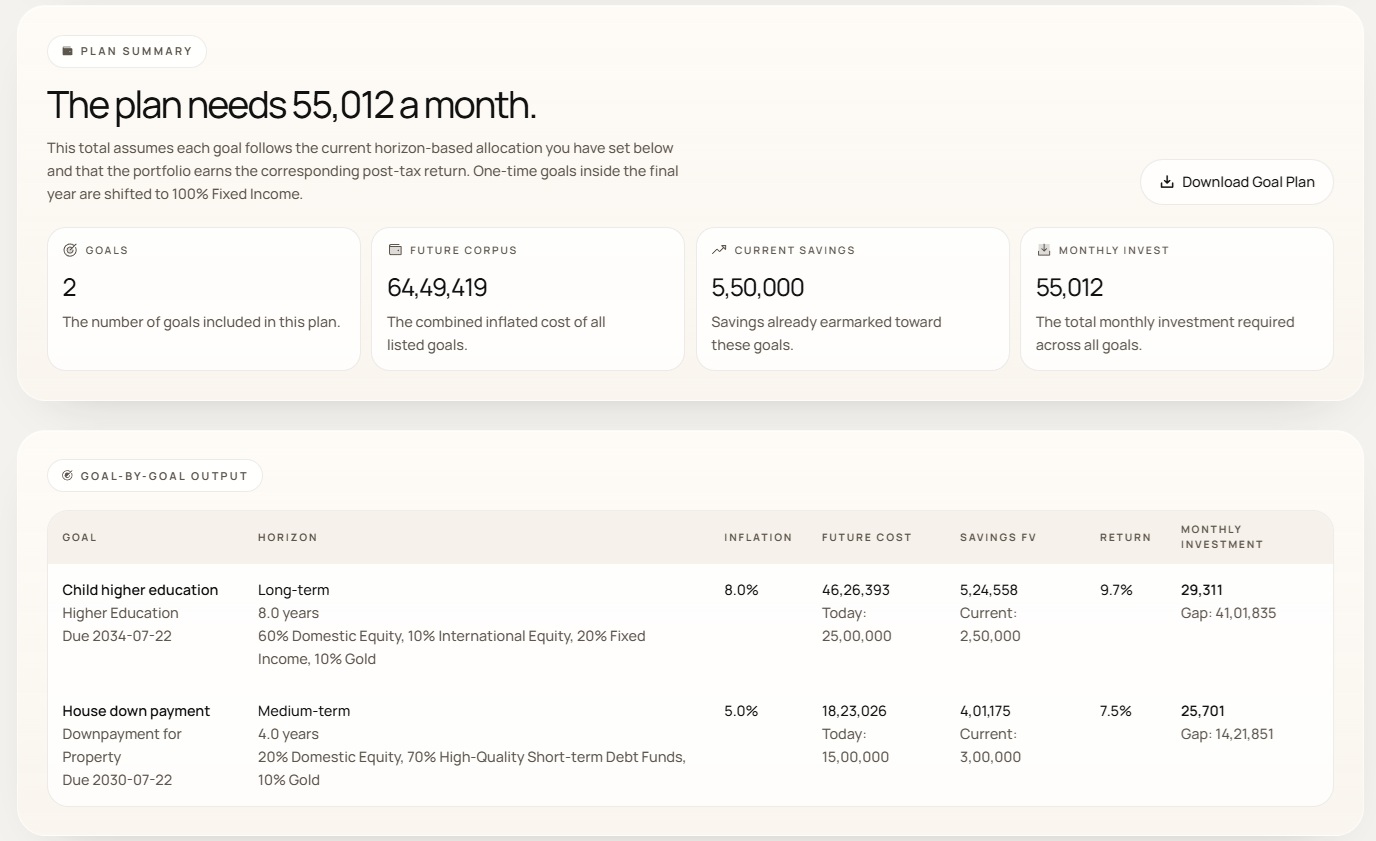
That didn't feel like planning. It felt like assembling pieces of a puzzle without ever seeing the complete picture. I wanted a tool that looked at financial planning the way most families actually experience it—not as one retirement goal or one education goal, but as a collection of goals that evolve together over several decades. That philosophy shaped every design decision in the Goal Planner. Instead of asking you to plan one goal at a time, the planner allows you to bring multiple goals into a single framework. Retirement, buying a house, children's education, a dream vacation, starting a business or achieving financial independence can all coexist within the same plan. This immediately gives you a much clearer picture of how your monthly savings are being allocated and whether your goals are realistic within your current financial capacity.
Another design choice was to move away from "one-size-fits-all" assumptions. Rather than forcing a single inflation rate or expected return across every goal, the planner encourages assumptions that are more closely aligned with the nature of each objective. It also recognises that investment strategy should evolve with the time horizon. A goal that is twenty years away deserves a different asset allocation from one that is only three years away. At the same time, I wanted to avoid making the tool unnecessarily complicated. Financial planning should be thoughtful, but it shouldn't feel intimidating. Most users should be able to create a meaningful plan in a few minutes, while those who enjoy going deeper can customise assumptions, fine-tune asset allocations and model different scenarios.
One feature that I personally find useful is the ability to experiment. What happens if you postpone buying a house by two years? How much does increasing your monthly investment affect your retirement corpus? What if education inflation turns out to be higher than you originally assumed? Instead of accepting a single answer, the planner encourages you to explore different possibilities and understand the impact of each decision before committing your money. Perhaps the most satisfying part of building this tool has been realising that good financial planning isn't about producing the "perfect" answer. There is no such thing. Every plan is built on assumptions about the future, and the future has a habit of surprising us.
What we can do, however, is build a framework that encourages better decisions. A framework that asks the right questions, uses reasonable assumptions and helps us understand the trade-offs involved in pursuing multiple financial goals. That, more than anything else, is what the FabTrader Goal Planner is designed to do.
How to access the Goal Planner tool
Final Thoughts: Investing Is Easy. Planning Is Hard.
If you've read this far, you've probably noticed that we've hardly discussed mutual funds, ETFs, stocks or any specific investment products. That wasn't an oversight. It was deliberate. The financial world spends an enormous amount of time discussing investment products. Every year, there are new funds, new investment themes and new opportunities that promise better returns than everything that came before them. As investors, it's very easy to believe that success comes from finding the "best" product.
I think the reality is quite different. Successful investing has far less to do with selecting the perfect investment and far more to do with following a sensible process. Once you know why you are investing, how much you need, when you need it and how much risk you can realistically afford to take, the universe of suitable investment options becomes surprisingly small. The difficult part isn't choosing between two index funds or deciding whether one flexi-cap fund is marginally better than another. The difficult part is understanding your own financial goals well enough to make those choices with confidence.
That is why I have always believed that investing should begin with planning, not products. Unfortunately, the opposite is what most of us experience. We are encouraged to compare returns before we define objectives, chase performance before understanding risk, and debate investment products before estimating how much money we actually need. It is hardly surprising that so many investors feel overwhelmed. Good financial planning doesn't eliminate uncertainty. Markets will continue to fluctuate. Inflation will surprise us. Life will throw up unexpected opportunities and unexpected expenses. Plans will need to be revised, assumptions will need to be updated and priorities will evolve over time.
But a good plan gives you something incredibly valuable. It gives you direction. Instead of reacting to every market headline, every YouTube recommendation or every social media trend, you begin making decisions based on whether they move you closer to your own goals. The focus shifts from "What's the best investment today?" to "Am I still on track to achieve what matters most to me?" That is a much calmer and, in my opinion, a much healthier way to invest. If there is one message I hope you take away from this article, it is this:
Don't begin your investment journey by asking where your money should go. Begin by asking what you want your money to accomplish.
Everything else follows from that answer. The mutual funds you choose. The asset allocation you adopt. The amount you invest every month. The level of risk you take. Even the returns you expect. These are all important decisions, but they should be consequences of a well-thought-out financial plan—not substitutes for one. The FabTrader Goal Planner was built around this philosophy.
It isn't designed to tell you which mutual fund to buy or which stock will outperform next year. Instead, it helps you step back and look at the bigger picture. It encourages you to define your goals, make realistic assumptions, understand the trade-offs between competing priorities and calculate the monthly investment required to turn those goals into reality. Whether you use my planner, your own spreadsheet or a notebook and a pen doesn't really matter. What matters is that you have a process. Because investing without a goal is little more than saving money with hope. Investing with a well-defined plan is how wealth is built—quietly, consistently and with purpose.
More from Investing
Is the Stock Market Quietly Killing Human Creativity and productivity?
For centuries, human progress has been driven by people who built things—engineers, scientists, entrepreneurs, artists and inventors. But as financial markets become...
Beyond Returns: Why I Built a More Intelligent Midcap Mutual Fund Screener
Looking for the best midcap mutual funds in India? This article explains how our Midcap Mutual Fund Screener goes beyond traditional return-based...
How to Build a robust Passive Index Investing System that works
Passive investing has transformed the way investors build wealth. But with so many choices—from Nifty 50 Index Funds and Nifty Next 50...