
Personal Finance
How to Choose the Right Mutual Fund Category

FabTrader
Article overview
When most people start investing in mutual funds, they usually ask the wrong question: “Which fund will give me the highest returns?”The better question — the one seasoned investors and financial planners ask — is:“Which mutual fund category is most suitable for my time horizon?”
When most people start investing in mutual funds, they usually ask the wrong question: “Which fund will give me the highest returns?”
The better question — the one seasoned investors and financial planners ask — is:
“Which mutual fund category is most suitable for my time horizon?”
Your investment timeline is the single biggest factor that decides whether you should be in debt, hybrid, or equity funds. Why? Because the risk and return potential of these categories are not the same across different durations. A category that is perfect for a 7-year wealth-building goal may be disastrous for a 7-day parking need.
That’s exactly the gap our Mutual Fund Category Guide by Investment Horizon is designed to fill. You can try the tool here and instantly discover which fund categories are recommended, which ones you should use cautiously, and which you must avoid for your chosen time frame.
Why Time Horizon Matters in Mutual Fund Investing
Imagine you want to buy a car in 6 months. Should you put that money in a small-cap equity fund? Definitely not. Equity markets are volatile in the short run, and a sudden correction could slash your car fund by 20% right when you need it. On the other hand, if you’re planning for retirement 20 years away, keeping all your money in a liquid fund makes little sense. You’ll miss out on the compounding power of equities.
In other words, time horizon protects you from the mismatch of risk and liquidity.
- Short horizon → Safety and liquidity matter more than returns.
- Medium horizon → Balance between stability and some growth.
- Long horizon → Growth becomes the priority; volatility can be tolerated.
The art of investing is aligning your goal timeline with the right mutual fund category.
Breaking Down Mutual Fund Categories by Time Horizon
Here’s how mutual fund categories stack up when viewed through the lens of investment duration:
1. Ultra-Short Horizons (1–8 days)
- ✅ Recommended: Overnight Funds
- ❌ Avoid: Everything else
If your money is needed within days, safety and liquidity are non-negotiable. Overnight funds are designed for this purpose — they invest in instruments that mature the next day.
2. Very Short Term (8–90 days)
- ✅ Recommended: Overnight, Liquid Funds
- ❌ Avoid: Equity, Hybrid, Long-term Debt
Liquid funds can handle short spans without taking undue credit or interest rate risk. They offer slightly better returns than savings accounts while ensuring accessibility.
3. Short Term (3 months to 1 year)
Here, categories like Ultra Short Duration and Money Market Funds begin to make sense. They generate a bit more yield than liquid funds, but without exposing you to equity market volatility.
4. Low to Medium Term (1–3 years)
At this stage, Short Duration Debt Funds and Conservative Hybrid Funds become appropriate. The idea is to take a little more risk than liquid funds to beat inflation, but not so much that market swings derail your goal.
5. Medium Term (3–5 years)
You can start introducing some equity, but carefully. Aggressive Hybrid Funds and Balanced Advantage Funds provide a cushion of debt while offering growth potential. Equity-only categories (like small cap) are still too risky.
6. Long Term (5+ years)
This is where equity shines. Categories like Large Cap, Flexi Cap, and Index Funds are excellent for compounding wealth. Mid-cap and small-cap funds can be considered, but only if your risk tolerance allows.
For very long horizons (7 years or more), equities should dominate, but you can diversify with Multi Asset Funds or Value/Contra Funds if you’re comfortable with their style of investing.
The Power of Avoiding Mismatches
Sometimes, the biggest wins in investing come not from what you choose, but from what you avoid. Parking your emergency fund in equity is a mistake. Locking your long-term retirement corpus in a liquid fund is also a mistake.
By using the tool, you’ll not only see the “recommended” categories but also the ones you must stay away from for your chosen horizon. This clarity helps you avoid costly mismatches.
Free Tool to Choose the Right Mutual Fund Category for your Investment : How to Use the Tool
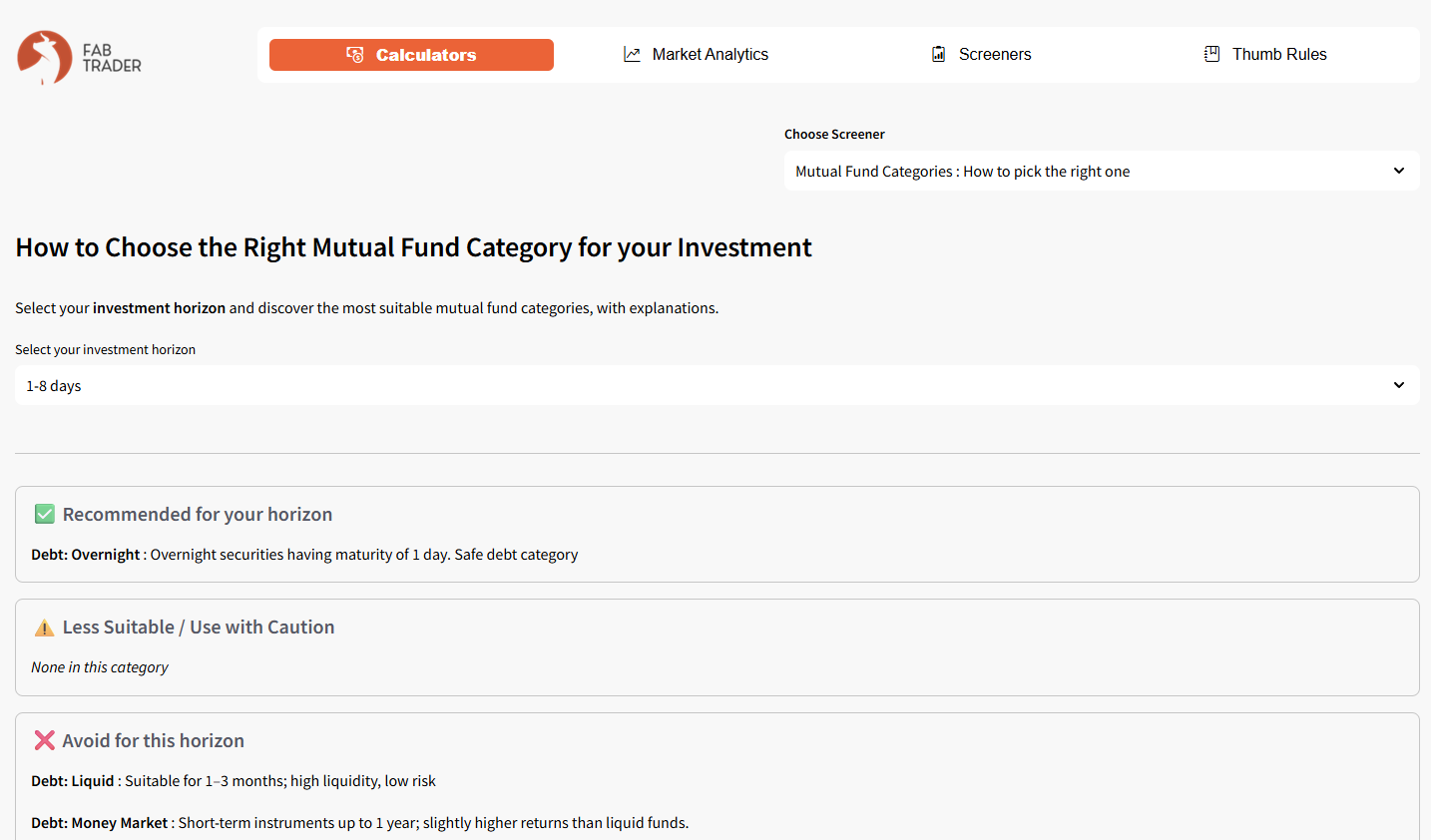
- Visit the Mutual Fund Category Guide by Investment Horizon.
- Under 'Screeners' you can find the tool 'Mutual Fund Category : How to Pick the Right one'
- Input your investment horizon and get a clear breakdown:
- ✅ Categories that fit your horizon
- ⚠️ Categories you can use with caution
- ❌ Categories to avoid
This isn’t just a recommendation tool — it’s also an educational guide that helps you learn the logic behind fund selection.
Final Thoughts
Mutual fund investing isn’t about chasing the “best” fund. It’s about choosing the right fund for your needs. Your time horizon is the anchor that keeps your investment strategy aligned with your goals.
The next time you plan to invest, pause for a moment and ask: “When will I need this money?”
Then let the answer guide you to the right category.
More from Personal Finance
Corporate Car Lease vs Buying a Car: How to Save Lakhs
If your employer offers a Corporate Car lease, buying a car may not be as straightforward as comparing one EMI with another....
What My Colleague’s Death Taught Me About Life, Family & Finances
There are some moments in life that don’t just shake you — they rearrange you from the inside. For me, a few...
The Soul of Wealth: Why Money Affirmations Matter More Than Math
Money is not just arithmetic—it’s emotion, psychology, and even philosophy. Most of us grow up with hidden money scripts like “rich people...