
F.I.R.E
The Triangle of Life: And the Quiet Art of Knowing When to Retire

FabTrader
Article overview
Every life has its own geometry. Some draw circles around routines, some build ladders out of ambition, and some simply let the years unfold like a straight line. But there’s one shape that inevitably defines all of us—whether we acknowledge it or not: the triangle of life.
Every life has its own geometry. Some draw circles around routines, some build ladders out of ambition, and some simply let the years unfold like a straight line. But there’s one shape that inevitably defines all of us—whether we acknowledge it or not: the triangle of life.
Its three sides are deceptively simple: Time. Health. Money.
Its shape, however, is never fixed.
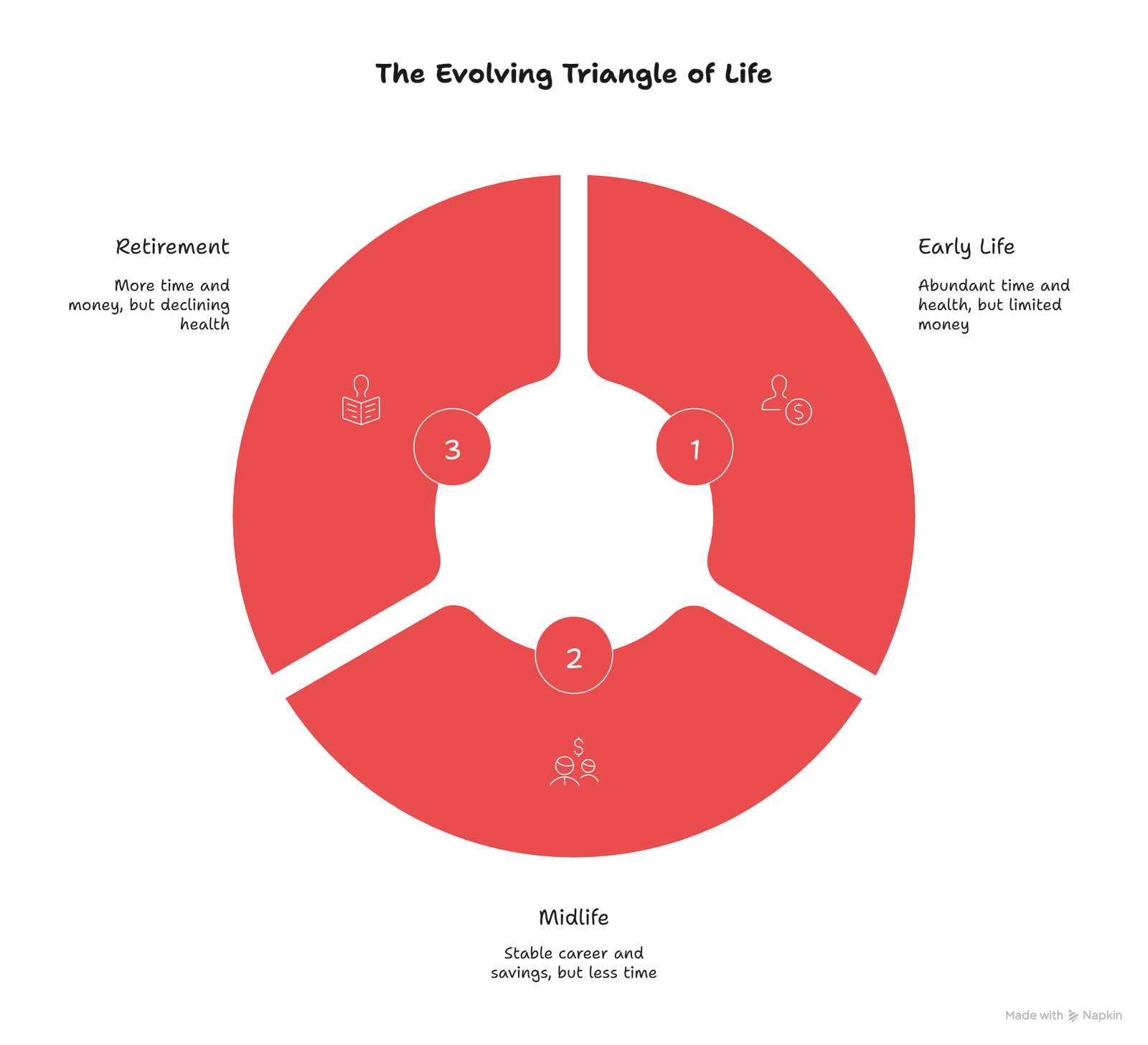
In our twenties and thirties, the triangle is lopsided. We brim with time, charged with health, but flat on the money side. Fast-forward to midlife and the dimensions shift. Careers stabilize, savings swell, and the money side of the triangle strengthens—just as time shrinks into a tight, fragile line. Still later, as retirement approaches, a strange paradox emerges: we finally have time and money at the same moment… while health quietly, inevitably, begins to taper.
Understanding this shape—how it expands, contracts, and tilts—may be the single most profound way to think about retirement. Because retirement, in truth, isn’t an age. It’s a geometry lesson in how we want to live the last, best chapter of our lives.
The First Triangle: Youth’s Abundance, Youth’s Blindness
In the first decades of life, time feels infinite. You can burn it, waste it, stretch it, laugh through it. Health is a silent, sturdy companion, the kind you don’t thank because you don’t yet understand fragility. Money? Well, that barely exists. But that’s fine—your body and your calendar compensate for the lack.
What you don’t realize then is that this version of the triangle is a gift you will never see again. You only understand its value retrospectively—usually when you’re too busy earning a living to enjoy the hours you once squandered.
The Second Triangle: The Productive Squeeze
This is the triangle society celebrates:
You have money now. You have competence. You have experience.
But your time? It has shrunk to a series of obligations—children, aging parents, deadlines, commutes, the flurry of “later, not now” that accumulates over years.
Health is still present, but no longer invisible. You start negotiating with your body. You start noticing things.
And it is here—in this squeeze between responsibility and resilience—that the retirement question first whispers. Not because you want to stop working, but because you begin to see the triangle for what it is: a dynamic shape that will not hold its form forever.
The Third Triangle: The Illusion of “Plenty of Time”
Many people treat retirement as the finish line. As if crossing 60 or 65 automatically delivers abundance.
“Yes, finally—time and money together.”
Except the third side begins to thin: health.
Not catastrophically. Not immediately. But slowly, like a dimmer switch you didn’t realize someone had touched.
This is the great misunderstanding of retirement.
Most imagine they are stepping into a long, wide-open chapter. But for many, only a portion of those years are lived with full vitality. Longevity isn’t the issue. Health span is.
Most people live long. Far fewer live well for long.
And that is why the triangle of life is more than a metaphor—it’s a warning.
The Fourth Triangle: The Sweet Spot We Rarely Recognize in Time
There is a fourth version of the triangle. A narrow window. A fleeting geometry where time, health, and money are—miraculously—nearly equal.
For some, this happens in their late 50s.
For others, mid-40s.
Some blessed few still feel it in their 60s.
This is the triangle almost nobody talks about. The triangle most people realize too late. The triangle when retirement is not about stopping work… but about starting life.
This is the moment where you are still strong enough to explore, still sharp enough to learn, still curious enough to begin again—and financially stable enough to choose.
Many people miss this window because they think the biggest barrier to retirement is money. But often the biggest barrier is something quieter: fear. The fear of spending what you saved. The fear of uncertainty. The fear of stepping into a new identity after decades anchored to a job title.
Yet data shows that most retirees who follow even conservative withdrawal rules end up spending less than they expected—and often finish with more than they started.
The real risk isn’t retiring too early. The real risk is retiring too late—when the triangle has already begun collapsing on one side.
Why Retirement Is a Shift in Gravity, Not a Full Stop
Retirement is often described as an ending — the point where work falls away and life becomes quieter. But that picture is too flat, too shallow. What actually happens is something far more subtle: the center of gravity in your life moves.
For decades, work sits at that center. It shapes your routines, your identity, even the rhythm of your thoughts. Retirement doesn’t remove that center — it simply frees you to build a new one. And this shift is less about stopping work and more about rediscovering what pulls you toward meaning when external expectations dissolve.
It’s not leisure that defines this phase. It’s intentionality.
The mornings you no longer rush through.
The conversations you finally have time to deepen.
The curiosity you no longer postpone to “someday.”
The inner questions that once sat at the edge of your awareness now move to the front:
What do I want my days to feel like?
What deserves my time now?
What matters enough to pursue without a paycheck attached to it?
Modern retirees occupy a rare moment in history. They are the first generation to reach this stage with a unique combination of advantages their parents never had — not luxuries, but tools for shaping life with clarity:
- A better understanding of health and longevity, so they can actively influence the quality of their later years instead of surrendering to chance.
- Access to endless learning, communities, and ideas, allowing them to stay mentally alive, connected, and relevant in ways unimaginable 30 years ago.
- The financial foundation built over decades, not for withdrawal, but for agency — the ability to choose what their time stands for.
The real essence of retirement isn’t escape. It’s alignment.
Aligning who you are with how you live. Aligning your values with your hours. Aligning your energy with pursuits that add something meaningful to the world — even if quietly, privately, or humbly.
When the triangle of life finally gives you time, money, and enough health on the same plane, the question stops being “What do I leave behind?”
And becomes:
“What do I want to move toward now?”
Retirement, at its best, is not an ending. It is the moment life becomes your own again — fully, deliberately, and without apology.
So the Real Question Isn’t “Can I Retire?”
The real question is far more uncomfortable:
“What am I risking by waiting?”
Because the world won’t send you a memo when your knees start hesitating, or when your energy stops showing up the way it used to. Decline doesn’t announce itself — it negotiates quietly, gradually, and always on its own terms.
And the cost of delay? It’s never measured in money.
It’s measured in unlived years — the experiences you meant to have, the places you meant to see, the version of yourself you planned to explore “once things settle down.”
Ask people who’ve already crossed the line into retirement, and a pattern emerges with almost eerie consistency:
“I should’ve done this sooner.”
They’re not celebrating a balance sheet. They’re mourning the seasons they didn’t claim when the triangle still worked in their favor.
Time. Health. Money.
The only moment they stand side by side — strong, stable, and ready — is a brief window. A window that closes faster than any of us expect.
And when it closes, it doesn’t reopen.
So the real danger isn’t stepping into retirement too early.
The real danger is waking up one day and realizing that life gave you the perfect moment… and you waited it away.
More from F.I.R.E
Goodbye, Bucket Strategy: How I built my Own Retirement OS
As I get closer to early retirement, I've realized that building a retirement corpus is only half the journey. The bigger challenge...
Financial Freedom: From One Rat Race to Another
Many people discover the FIRE (Financial Independence, Retire Early) movement hoping to escape the corporate rat race, only to find themselves trapped...
The FIRE Dream in India Is Changing — And Most People Haven’t Realised It
India’s growth story looks stronger than ever on paper. But beneath the headlines, something important is changing for salaried professionals, investors, and...